The Best Ping Reducer for India: An Honest 2026 Guide
The best ping reducer for India is the one that measures your route first and refuses to engage when it can't beat your direct connection. That's not a dodge. Most players in India connect to servers inside India, over routes that already sit close to the physical minimum, and no reducer at any price improves those. What follows is where your game servers actually are, which ISP quirks a reducer can genuinely fix, and what to demand before you pay a single rupee.
The honest answer first
A ping reducer rents you a different path to the game server. That's the entire product. When your ISP's path is bad, a better path saves real milliseconds. When your ISP's path is already clean, which for India-hosted games it usually is, a reducer adds a hop and either changes nothing or makes things slightly worse.
So the best ping reducer for India isn't the one with the most locations or the one your favourite streamer uses. It's the one that proves, on your connection, against your game's actual server, that it found a faster path, and admits it plainly when it didn't. Roughly one connection in ten has a route problem worth paying to fix. The other nine, the right answer is direct, and any product that hides that from you is not on your side.
Full disclosure up front: we build one of these tools. Smart Route is ours, and it appears at the end of this guide with its bias clearly labelled. Everything before that section is useful with zero purchase.
Where India's game servers actually are
You can't judge a route without knowing the destination, and most advice online quietly assumes you're American. Here's the server geography that matters for India as of mid-2026, with the ping a clean fibre connection in a metro should see. If you're far outside these ranges, you have a route problem, not a hardware problem.
| Game | Servers you'll usually hit | Realistic ping on clean metro fibre |
|---|---|---|
| BGMI | India (Mumbai-region cloud), some lobbies in Singapore | 10-45 ms India, 55-85 ms Singapore |
| Free Fire MAX | India servers, Singapore for some modes | 15-50 ms |
| Valorant | Mumbai (Riot's South Asia site) | 5-45 ms depending on your city |
| CODM | Often Singapore for Indian players | 40-75 ms |
| Genshin / Star Rail (Asia) | Singapore or Japan, depending on title | 45-130 ms |
| Middle East regions (several shooters) | Bahrain cloud region | 35-65 ms from western India |
Server locations shift, so treat the middle column as "usually" rather than gospel. But notice what's missing: nothing in Europe or North America matters to the Indian mainstream. A ping reducer whose network is concentrated in Frankfurt and Dallas is close to useless here, whatever its marketing says. The PoPs that matter for India sit inside India itself, plus Singapore for Asia lobbies and Bahrain for Middle East servers.
If BGMI is your main game, the dedicated guide on lowering ping in BGMI goes deeper on its matchmaking and server behaviour.
Jio, Airtel, ACT, BSNL: your ping is decided in a carrier hotel
Two connections in the same city, playing the same game, can differ by 40 ms. The difference is peering: where your ISP physically hands traffic to the network hosting the game server.
India's public internet exchanges, the ones NIXI operates, have historically carried a small slice of the country's traffic. Most real interconnection happens through private peering and the big commercial exchanges in Mumbai and Chennai carrier hotels; DE-CIX Mumbai has grown into one of the largest exchanges in the region. If your ISP and the game's cloud provider meet there, an India server feels local. If they don't, your packets can leave the country just to shake hands.
That's the classic Indian route failure. You're in Hyderabad, the server is in Mumbai, and your traffic detours through Singapore because that's where the two networks peer. Eight milliseconds becomes seventy. It looks absurd on a traceroute, and it's completely real.
Patterns we see repeatedly, hedged because routes change monthly and differ by circle:
- JioFiber is usually clean to India-hosted games. Jio mobile is a different animal: CGNAT plus radio latency means the same game on 5G often sits 20-40 ms higher, with more jitter.
- Airtel often has the most direct paths to Mumbai-hosted servers thanks to broad peering. Often, not always.
- ACT, Excitel and local fibre ISPs run excellent last miles but buy upstream transit, so your route depends on whose backbone they hand you to. Inside their home cities they're great; across regions you sometimes trombone through another metro first.
- BSNL reaches places nobody else does and produces the strangest routes of the lot. Hairpins via distant exchanges are more common. If it's your only option, a relay entry point near you matters more than it does for anyone else.
Don't take any of this on faith, including from us. Run a traceroute to your game's region and see where the latency jumps; the guide to reading a traceroute shows exactly what a hairpin looks like. And if your ping is fine at 2 pm and ugly at 9 pm, that's a different disease: read why evening lag happens before you blame the route.
What a ping reducer can genuinely fix in India
When one of these tools earns its fee, it's for one of four reasons.
- Hairpin routes. Your traffic leaves India to reach an Indian server. A relay entry in your region keeps the path domestic. This is the biggest win, 15-40 ms when it applies.
- Peering mismatches. Your ISP and the game's host don't meet at a nearby exchange, so packets wander through two extra networks. A well-connected relay skips the detour. Typically 5-15 ms.
- Evening congestion on one segment. If the congestion sits at a specific interconnect rather than on your own line, a route around it helps during peak hours and does nothing at 2 pm. The same tool can win at night and lose in the morning, which is exactly why per-session measurement matters.
- Cross-border play. Singapore lobbies in BGMI, Asia servers in Genshin, Middle East servers in some shooters. Your ISP's path to the cable landing station, or beyond it, is sometimes lazy, and a good relay path saves 5-20 ms. Sometimes it saves nothing, because the direct path already was the cable.
One more honest wrinkle: sometimes the win isn't average latency but stability. A route with the same average ping and half the jitter feels dramatically better in a shooter. Judge both, not just the headline number.
What no reducer can fix, at any price
- Distance. Chennai to Singapore is about 2,900 km of ocean. Light in fibre needs roughly 29 ms for the round trip even on a perfect cable, and real cables aren't perfect. If you see 38 ms to Singapore, that's a good route, not a broken one.
- Your Wi-Fi. A congested 2.4 GHz link adds 5-30 ms of jitter that no relay can touch. Wire the PC or fix the wireless first.
- Bufferbloat. If your ping doubles whenever someone in the house starts a video, the queue lives inside your own router. That's free to fix and no subscription helps. Start with what bufferbloat is.
- Mobile radio latency. 4G and 5G add their own round trip before your packet ever touches the internet. A reducer operates after that point.
- The server itself. An overloaded server or a low tick-rate game feels laggy at any ping. No route fixes the far end.
What the best ping reducer for India must prove
Whatever you shortlist, in 2026 you're entitled to demand all five of these. A tool missing any of them is asking for trust it hasn't earned.
- Indian PoPs, plural. One Mumbai node is not coverage for a country this size. You want entry points near your circle, such as Delhi for the north and Chennai and Bengaluru for the south. Bahrain matters if you play Middle East regions.
- Measurement before engagement. The tool should compare direct against relay for your actual server, on your actual connection, before it routes anything. Not a global average. Not a marketing number.
- A visible "no." If direct is faster, the tool should stay direct and say so. A reducer that always claims a win is lying a large fraction of the time, because physics says direct wins often.
- Receipts. Per-session records of what was measured and what was saved, in milliseconds, that you can read afterwards.
- Anti-cheat safety. Network-level routing only. No injection, no hooks into the game process, no kernel driver. That's what keeps this category in the same safety bucket as a VPN rather than a cheat.
A ping reducer that can't show you the route it beat is selling you a feeling, not milliseconds.
If you're unclear on why this category even exists separately from VPNs, the comparison of GPNs versus VPNs for gaming covers it: same tunnel idea, opposite purpose and routing logic.
Price sanity in INR
Most ping reducers price in dollars, commonly somewhere between 6 and 10 US dollars a month, which lands around 500 to 900 rupees. That's a full battle pass, every month, for a tool that physics says helps maybe one player in ten. Some of the established names are genuinely good engineering, but the pricing assumes an American wallet.
Three fair questions before you pay. Is there real INR pricing, not a dollar price converted at checkout with forex fees stacked on top? Can you test the measurement for free before the routing is paid? And can you cancel without a fight?
We geo-price in INR for India; see the pricing on the Smart Route page if you want the number. This article stays useful if you never look.
The free-test-first path
For most people the best ping reducer in India is no reducer at all: a wired connection and a fixed router queue. Spend nothing until the data says a route problem exists. In order:
- Wire the connection if you play on PC or an emulator. Ethernet removes an entire category of jitter before you measure anything.
- Grade your bufferbloat with the Waveform bufferbloat test. Anything below an A means your own router is a bigger enemy than your ISP's routing.
- Ping the regions you play and note the numbers at 2 pm and again at 9 pm. Stable at both times and inside the ranges from the table above? Your route is fine. Stop here and put the money into the battle pass instead.
- Traceroute anything suspicious. A big latency jump at one hop, or hostnames that suddenly mention Singapore on the way to an Indian server, is your evidence.
- Only then trial a reducer, and only one that measures your route and shows receipts.
The measurement half of this is free in the free download of BRUTAL Optimizer: ping test to game regions, traceroute, a bufferbloat grade, and a DNS benchmark. The DNS benchmark, to be clear, speeds up lookups and does nothing for in-game ping. We label it that way inside the app too.
Where Smart Route fits, bias disclosed
Smart Route is our GPN, so weigh this section accordingly. We built it around the exact demands listed above, because we were tired of tools that couldn't meet them. It runs inside BRUTAL Optimizer for Windows, so it routes the games you play on a PC, mobile titles included when you play them through an emulator. Its PoPs include three in India, in Chennai, Bangalore and Delhi, plus Bahrain for Middle East servers and Singapore, Tokyo and Jakarta for Asia. It detects your live game's server connection read-only, with no injection, no hooks and no kernel driver. It measures direct against relay for your connection, engages only when the relay provably wins, and stays direct otherwise. Every session ends in a Route Receipt: milliseconds saved when we won, and "Direct won" recorded just as visibly when we didn't.
Routing is paid; the measurement tools are free forever. If your receipts keep saying direct wins, believe them, keep your money, and enjoy the route you already have. That's not the product failing. That's the product working.
Frequently asked questions
Do ping reducers actually work for BGMI in India?
Usually not, because BGMI's main servers are hosted in India and most fibre connections already reach them near the physical minimum. They help when your ISP hairpins traffic abroad to reach an Indian server, or in Singapore lobbies where your ISP takes a lazy path. Measure your route first; if it's clean, save the money.
Which is the best free ping reducer for India?
Honestly, there's no good fully-free routing product; free routing tiers tend to be throttled, ad-heavy, or both. What you actually want free is measurement: ping tests to game regions, traceroute, and a bufferbloat grade. Those often reveal that no purchase is needed at all.
Can a ping reducer lower ping from India to Singapore servers?
Sometimes, typically by 5-20 ms, when your ISP takes a poor path to the cable landing station or beyond it. It can't beat distance: roughly 30 ms round trip is the physical floor from south India, more from the north. If you already see 35-45 ms to Singapore, your route is good.
Are ping reducers safe with BGMI and Valorant anti-cheat?
Network-level routing that never touches the game process is generally treated like a VPN and is broadly safe. Avoid anything that injects code, hooks the game, or installs a kernel driver to 'boost' it. If a tool can't clearly state it does none of those, don't run it next to an anti-cheat.
Why is my ping high only in the evenings in India?
Peak-hour congestion, either at your ISP's interconnects or inside your own router as bufferbloat. A ping reducer only helps if the congested segment is one it can route around. Bufferbloat is fixed for free at your router, so grade that first before paying for anything.
Keep reading
 Gaming & FPS
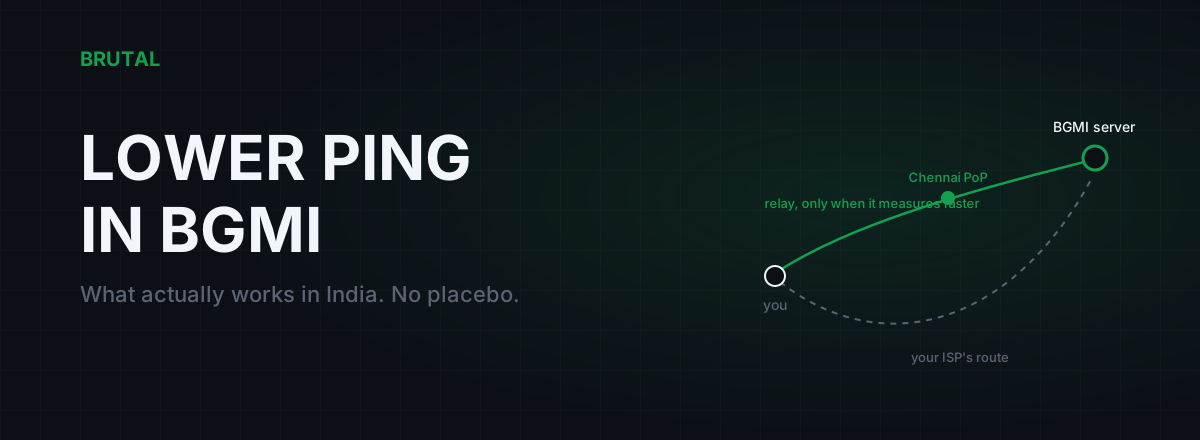
How to Lower Ping in BGMI: What Actually Works in India
Most BGMI lag in India comes from your ISP's route and your own WiFi, not your phone. An impact-ordered checklist of what lowers ping, what's placebo, and when to take it up with your ISP.
 Network & Latency
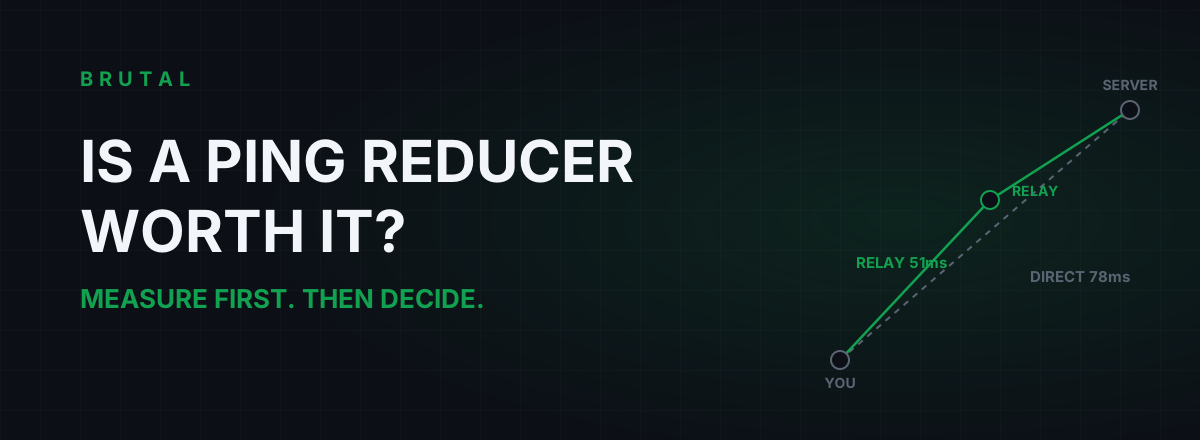
Is a Ping Reducer Worth It? A Decision You Can Test for Free
Most players don't need a ping reducer. Some genuinely do. A free ten-minute measurement tells you which one you are, before any subscription starts.
 Network & Latency
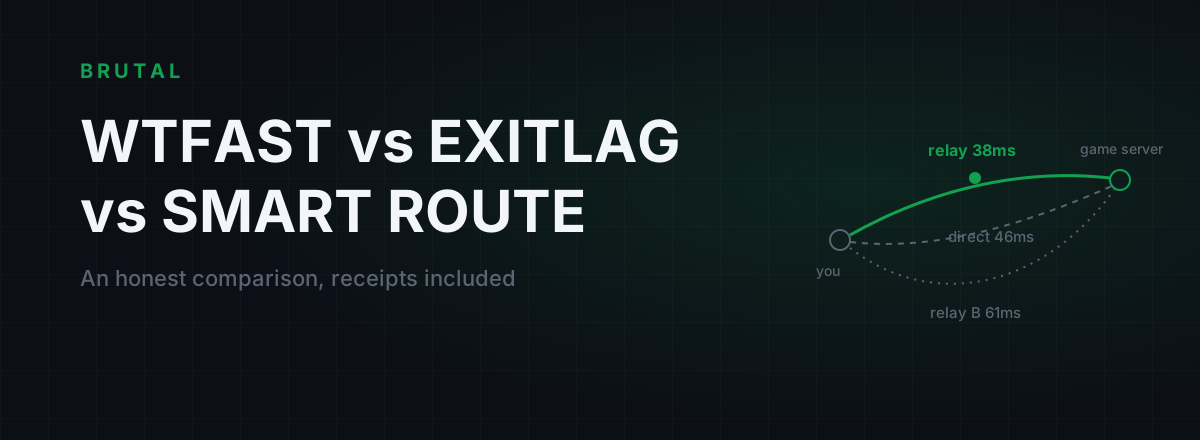
WTFast vs ExitLag vs Smart Route: An Honest 2026 Comparison
Three ping reducers, one honest comparison from a vendor with skin in the game. Where ExitLag and WTFast genuinely beat us, where measurement-first wins, and when none of the three will help.
Stop guessing. Measure it.
BRUTAL Optimizer is the honest way to speed up Windows — 17 free modules, a real FPS overlay, verified disk cleanup and drive health. No kernel driver of our own, no game hooks, and per-module undo for the settings it changes.