WTFast vs ExitLag vs Smart Route: An Honest Comparison
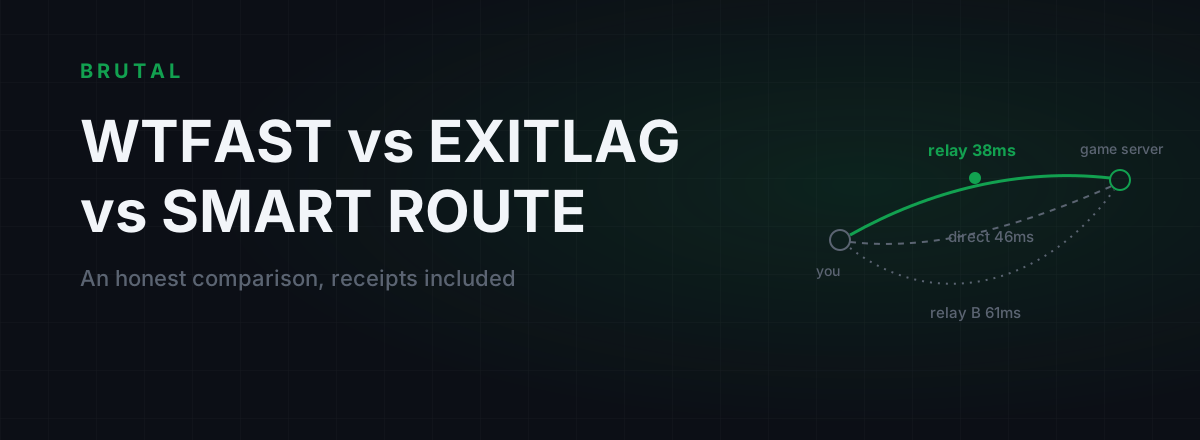
Full disclosure before anything else: we make Smart Route, one of the three tools in this comparison. Read it with that in mind. The short answer to the WTFast vs ExitLag question is that ExitLag is the stronger of the two for most people in 2026, mainly on game support and regional coverage. Smart Route competes on something different: it measures your direct route against its relays every session and refuses to route when routing won't help you.
Read this with one eyebrow raised
A vendor reviewing its own competitors has an obvious incentive problem. We know that, and you should too. So here are the rules this article was written under: every real WTFast and ExitLag strength gets named plainly, every Smart Route weakness gets named just as plainly, and nothing here promises a guaranteed result, because no routing tool can honestly promise one.
Our weak spots first. Smart Route's relays sit in Singapore, Tokyo, Frankfurt, Chennai, Bangalore, Delhi, Jakarta, São Paulo, Dallas and Bahrain. WTFast and ExitLag both run larger networks. If you live far from all of those locations, they have more chances to find you a winning route than we do. That's real, and it comes up again below.
Second rule: don't take our word for any of this. All three tools can be tested cheaply or free. Your connection, your ISP, and your game's server region decide the winner, not a comparison table.
What all three actually do
WTFast, ExitLag, and Smart Route are all gaming route relays. Strip the branding and the mechanism is identical: instead of letting your ISP pick the path your game traffic takes, the tool sends it through a relay server sitting on a network with better routing, and the relay forwards it to the game.
That helps in exactly one situation: when your ISP's path to the game server is bad. Congested evening peering. A detour through the wrong city. A lossy transit link someone should have fixed months ago. In those cases a relay can genuinely cut 5 to 30ms, sometimes more when the direct route is properly broken, and it can calm jitter and packet loss along the way.
When your route is already clean, all three tools are useless. Not slightly useful. Useless. A relay is a detour, and a detour only wins when the main road is jammed. Distance sets a hard floor on latency that no software touches. If you're in Mumbai playing on a Mumbai server over decent fiber, nothing any of these tools does will beat your direct 15ms.
How often does routing actually win? It depends on your ISP and region, and anyone who hands you one universal number is selling something. On a well-peered fiber connection near the server, maybe one session in ten sees a real improvement. On a congested ISP a continent away from the server, it can be most evenings. That spread is exactly why measurement matters more than marketing.
WTFast vs ExitLag head to head
WTFast is the veteran. It has been around since roughly 2010 and it coined the GPN term the whole category now uses. That history buys it a broad server network, claimed support for thousands of games, and name recognition. It works the way it always has: pick your game, pick or auto-select a route, play. When its routes happen to beat your ISP's, it delivers.
Its weaknesses are the flip side of its age. Results vary a lot by region and ISP, the client has evolved slowly, and the marketing has historically run ahead of the evidence. WTFast tells you it improved your connection; it has never been keen on showing you what the same session would have looked like without it.
ExitLag is the challenger that overtook it in much of the world. Born in Brazil in the late 2010s, it's huge in South America and Southeast Asia, which happen to be the regions where ISP routing is most often bad and a relay most often wins. Its curated list covers more than a thousand games, each with tested routes and per-region server selection. Its multipath feature sends duplicate copies of your traffic down several routes at once and uses whichever copy arrives first.
Be clear-eyed about what multipath is, though. It's duplication, not magic. It mostly helps with packet loss and jitter rather than raw latency, and it spends extra bandwidth to do it. Useful on flaky routes, irrelevant on clean ones.
If the question is strictly WTFast vs ExitLag, our honest read is that ExitLag wins for most people in 2026: bigger curated list, stronger presence in the regions where routing matters most, generally lower price. WTFast still makes sense if its network happens to hold the winning route for your specific ISP-to-server path, which only a trial will tell you.
Measurement transparency: prove it or it's vibes
Here's the criterion this whole comparison turns on, and the reason Smart Route exists at all.
Both WTFast and ExitLag show you an improvement number while you play. What neither shows you is the controlled comparison: what your ping would have been, right now, on the direct route, without the tool running. The number on screen is produced by the thing that wants your renewal. That doesn't make it fake. It makes it unverifiable.
A ping reducer that can't show you the route it beat isn't reporting a result. It's reporting a feeling.
Smart Route inverts this. Before it touches your traffic it detects the game's live server connection read-only, no injection and no hooks, then measures the direct path against candidate relays on your actual connection. It engages a relay only when the measurement shows a real win. Every session ends in a Route Receipt: milliseconds saved when a relay won, or “Direct won” when your ISP's route was already the best available. The decision logic is documented in how Smart Route decides between relay and direct, and none of it asks you to trust a vibe.
Could WTFast or ExitLag build the same thing? Sure. The measurement isn't hard. The uncomfortable part is publishing the sessions where your product did nothing.
The honesty test: what happens when routing can't help
Run any of these tools on a clean connection and you learn what each one is really selling.
WTFast and ExitLag route your traffic anyway. You subscribed, the tunnel is on, and your packets flow through their network whether the detour is winning or losing. On a clean route that usually costs you a couple of milliseconds, and the in-app display will still find something encouraging to say.
Smart Route stays direct and writes “Direct won” on the receipt. You paid for routing and it tells you, in plain text, that routing lost tonight. We think that's the only defensible behavior for this category, and we wrote up the reasoning in why your ping reducer should tell you no.
Game support and server coverage
This is where ExitLag genuinely leads. Its game list is a real product feature: over a thousand titles, each with tested routes and per-region server selection, maintained by an actual team. If your game is on the list, setup takes close to zero thought. WTFast claims support for thousands of games as well, though the depth of per-game tuning is harder to see from the outside.
Smart Route doesn't use a game list. It watches which server your game is actually talking to, read-only, and measures routes to that. The upside: no waiting for your game to be added, and a patch that changes server IPs breaks nothing. The downside: you don't get a hand-curated "best route for game X in region Y" that a human verified last week. We think live measurement beats a static list, but that's an architectural bet, not a settled fact.
On raw coverage, the honest picture reverses. A smaller relay network against ones several times larger means fewer candidate routes. Where our PoPs sit close to the big game-server regions we're competitive: South Asia, Southeast Asia, East Asia, Europe, North and South America, the Gulf. If you play from somewhere far from all of them, ExitLag or WTFast simply has more darts to throw.
Price, trials, and refunds
Prices move, so treat these as mid-2026 ballparks and check the vendors' sites before quoting anyone. WTFast has historically run around 10 US dollars a month, cheaper on annual plans. ExitLag usually lands around 6 to 8 dollars a month depending on plan length, with a 3-day free trial. Neither company is famous for generous refunds; both lean on trials instead, so read the current terms before paying for a year up front.
Smart Route is part of Ultra, which is $9.99 (charged as ₹899) a year and renews each year until you cancel; the pricing page has the details. The measurement layer is free with no subscription: ping tests to game regions, traceroute, a bufferbloat grade, and a DNS benchmark all ship in the free download. That's deliberate. If the free measurements show your direct route is already clean, you shouldn't buy routing from us or from anyone else.
Anti-cheat safety
All three are user-mode network tools. They move packets; they don't inject into the game, hook its process, or load anything into the kernel on its behalf. Routing tools of this type have been used by millions of players for over a decade without ban waves targeting them, which is about as strong as the evidence gets short of a publisher writing it down. The longer version, including the edge cases worth knowing, is in are ping reducers anti-cheat safe.
Which one should you pick
| Criterion | WTFast | ExitLag | Smart Route |
|---|---|---|---|
| Heritage | The original GPN, around since roughly 2010 | Late 2010s, dominant in LATAM and SEA | Newest of the three (and yes, ours) |
| Game support | Thousands claimed, per-game setup | 1,000+ curated titles with tuned routes | Detects the live server connection, no list |
| Routing tech | Relay route selection | Relay routes plus multipath duplication | WireGuard relays, engaged only on a measured win |
| Proves the win per session | No direct baseline shown | No direct baseline shown | Route Receipt every session |
| When routing can't help | Routes anyway | Routes anyway | Stays direct, records “Direct won” |
| Server coverage | Large global network | Large global network | Smaller network |
| Free tier | Trial only | 3-day trial | Measurement tools free forever |
Pick ExitLag if your game is on its list, you play from South America or Southeast Asia, and you want the most mature curated-routes product. It's the best version of the traditional GPN.
Pick WTFast if you've trialed it and its network happens to win on your specific path. History and breadth are worth something, but only a test tells you whether they're worth something to you.
Pick Smart Route if you want proof over promises: measurement before routing, a receipt after every session, and a tool that will tell you to your face that your ISP won tonight. Accept the trade honestly too, because with a smaller relay network we can't match the coverage depth of the incumbents everywhere.
Or pick none of them. If your ping already sits at the distance floor and your route is clean, the honest answer to whether a ping reducer is worth it is no, and no vendor comparison should talk you out of that.
Frequently asked questions
Is ExitLag better than WTFast in 2026?
For most players, yes. ExitLag's curated game list, its server presence in South America and Southeast Asia, and its typically lower price make it the stronger traditional GPN. But the only comparison that matters is the one on your connection: trial both against the server you actually play on, at the hours you actually play.
Do WTFast and ExitLag actually lower ping?
Sometimes. They help when your ISP's route to the game server is congested or badly peered, where a relay can save 5 to 30ms and occasionally more. On a clean route they do nothing, and the detour can even add a millisecond or two. No routing tool beats distance.
What makes Smart Route different from WTFast and ExitLag?
It measures before it routes. Smart Route compares your direct path against its relays for your live game connection, engages a relay only when it provably wins, and records every session as a Route Receipt, including the sessions where it stayed out of the way and reported that direct won.
Are ping reducers like WTFast, ExitLag, or Smart Route bannable?
They're user-mode network tools that route packets without touching the game's process, and the category has been used widely for over a decade without ban waves aimed at it. The risk is low but never provably zero; check your game publisher's stance if you're worried.
Which ping reducer is best for players in India?
India is well covered by Smart Route, with relays in Chennai, Bangalore and Delhi. ExitLag also serves India well and has the deeper game list. Measure each against your game's actual server region, using ExitLag's trial and Smart Route's free measurement, and let the numbers decide.
Keep reading
 Network & Latency
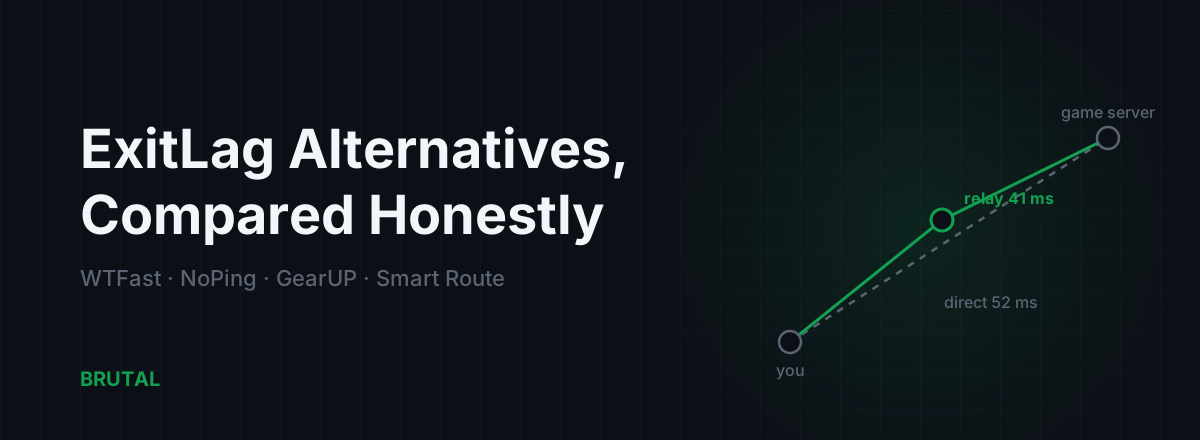
ExitLag Alternatives in 2026: An Honest Comparison
A criteria-first look at WTFast, NoPing, GearUP and Smart Route. What ExitLag does well, what actually matters in a ping reducer, and how to run a fair trial before you pay.
 Network & Latency
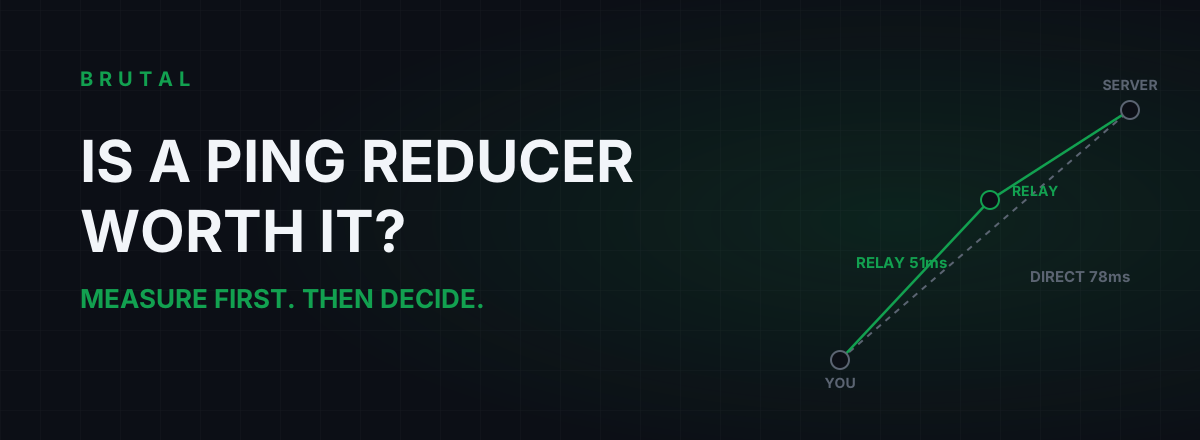
Is a Ping Reducer Worth It? A Decision You Can Test for Free
Most players don't need a ping reducer. Some genuinely do. A free ten-minute measurement tells you which one you are, before any subscription starts.
 Network & Latency
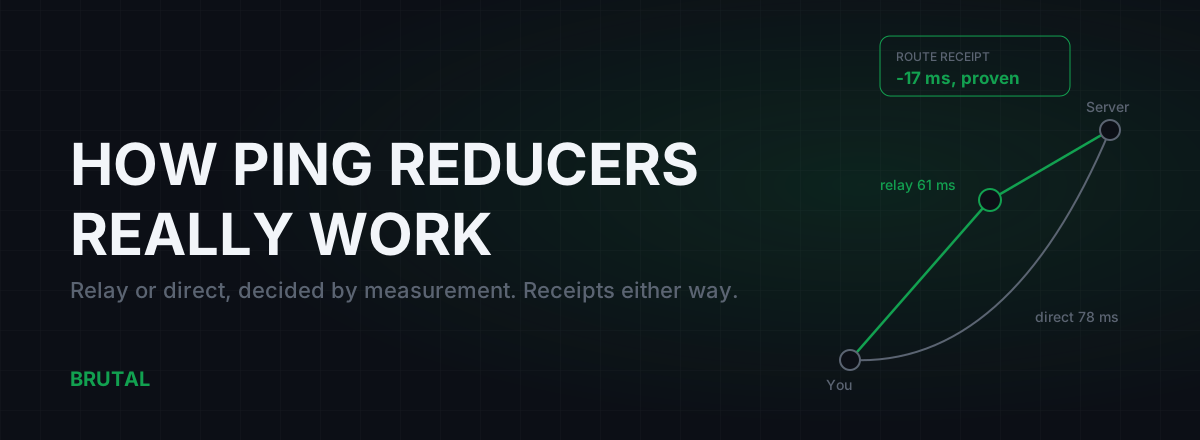
How Do Ping Reducers Work? Relay vs Direct, With Receipts
A ping reducer only helps when a relay path genuinely beats your ISP's route. Here's how Smart Route detects the server, measures both paths, and decides, with a receipt either way.
See whether a relay beats your route.
Smart Route times your direct path and each relay with the same probe, and engages a relay only when it measurably wins — otherwise it stays on your normal connection and says so. Measuring your route is free; engaging a relay is part of Ultra.