How Do Ping Reducers Work? Relay or Direct, With Receipts
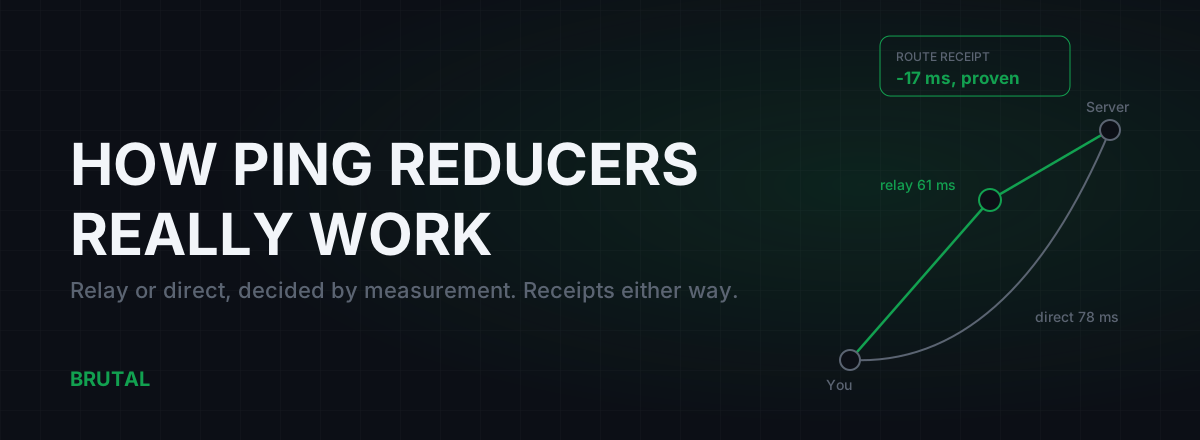
A ping reducer works by carrying your game traffic through a relay server that sits on a better network path than the one your ISP picked. That's the entire trick, and it only pays off when your ISP's path is genuinely bad, which happens less often than the marketing suggests. This is a walk through how ping reducers work when they're built honestly: detect the server, measure both paths, reroute only on a proven win, and write the result down either way.
How do ping reducers work? The short answer
The internet doesn't send your packets along the shortest path. It sends them along paths your ISP and its transit partners have agreed to carry, and those agreements are negotiated on cost, not latency. Your traffic from Delhi to a Singapore game server might detour through a congested exchange, or hand off to a transit provider that's cheap for your ISP and slow for you. Run a traceroute and you can watch it happen hop by hop.
A ping reducer, or a gaming private network if you want the proper name, rents servers in well-connected data centers and offers your packets an alternative route. Your traffic rides an encrypted tunnel to a relay, and the relay forwards it to the game server over data-center transit that usually has cleaner peering than a consumer ISP. When the relay's combined path is shorter or less congested than your default route, your ping drops. When it isn't, the relay is a detour, and detours cost milliseconds instead of saving them.
Realistic wins are 5 to 40 ms on routes that are misrouted or congested, occasionally more when a route is truly broken. On a clean route there's nothing to reclaim, and a good tool should say so out loud.
Step one: find the game server, read-only
You can't measure a path if you don't know where it ends. Games don't announce their server addresses. Matchmaking hands you a different machine every session, often in a different city, and the address lives inside the game's own network traffic.
There are two ways to get it. The invasive way is to hook the game, inject code, or watch its memory. It works, but every one of those techniques looks exactly like a cheat to an anti-cheat driver, which is why the sane rule is user-mode only, hands off the game process. If that trade-off matters to you, and it should, read whether ping reducers are anti-cheat safe before installing anything.
The boring way is to ask Windows. The operating system already keeps a table of every open connection: which process owns it, which remote address and port it's talking to. Reading that table is the same thing Resource Monitor does when you open its Network tab. Smart Route does it this way on purpose. No injection, no hooks, no kernel driver, nothing inside the game's memory space. The game never notices it's being observed, because the observation happens entirely outside it.
Step two: measure direct against every relay
Once the server address is known, the question stops being philosophical and becomes arithmetic. Two numbers get compared.
First, the direct baseline: a burst of probes from your machine to the game server over your normal route. Not one ping. One ping is a coin flip. A burst gives you a median, a jitter figure, and a loss percentage, which together describe what the route actually feels like in a match.
Second, each relay candidate. A relay path has two legs: your machine to the relay, then the relay onward to the game server. Both legs get measured, because a relay with a gorgeous connection to the server is useless if your leg to it is slow. Smart Route's relays run from Singapore and Tokyo through Chennai, Bangalore, Delhi and Bahrain to Jakarta, Frankfurt, Dallas and Sao Paulo, but for any given server only the plausible ones get serious attention. A Frankfurt relay is not a candidate for a Mumbai game server. The geometry is silly.
Two details make this honest instead of decorative. The measurement is of your connection, tonight, not a global average from someone else's dashboard. Routes shift with time of day, and evening congestion at peering points can make a path that was fine at noon fall apart at 9 pm. And stability counts as much as speed: a relay that's 3 ms faster on the median but doubles your jitter is a downgrade for gaming, and the decision logic treats it as one.
Step three: engage only on a proven win
Now the rule, and it's short: the relay path must beat the direct path by a margin that's meaningful and stable. Not by a millisecond of noise. Not on a single lucky probe. If the best relay wins clearly, the tunnel engages and your game traffic starts flowing through it. If it doesn't, nothing engages, your traffic stays exactly where it was, and the session gets recorded as "Direct won".
The margin matters more than it sounds. A tool that flips routes every time the numbers wobble is worse than one that never routes at all, because a mid-match route change is exactly the kind of disruption you installed the thing to avoid. So a win has to hold across the whole measurement, not one flattering probe, and once the decision is made it stays made for the session unless the chosen path actually degrades.
That second branch is not a consolation prize. It's the product working. The decision is re-checkable, the evidence is kept, and no packet takes a detour that hasn't earned itself first.
Why "Direct won" is a feature, not a failure
Here's the uncomfortable truth of this product category: on a decent connection, the direct route wins most sessions. If you're on good fiber with sane peering to a nearby server, a relay may clearly win maybe one session in ten, sometimes fewer. On a rough ISP-and-region combination, say a misrouted path to a distant server at peak hour, it can be most evenings. You don't know which group you're in until you measure, and neither does anyone selling you the tool.
If your ping reducer never tells you no, it isn't measuring your route. It's billing you for a detour.
A tool that routes you through its relays unconditionally has a business reason to do so. It makes the product feel active whether or not it helps. The measurement-first approach costs sales in the short run, because "Direct won" is a strange thing to put in a marketing deck. It's still the right design, and it's why a ping reducer should be able to tell you no. The relay is a tool for a specific, measurable problem. It's not a lifestyle.
Fail-safe means direct, always
One more architectural choice worth understanding: the direct route is the resting state, and everything about the relay is built to collapse back to it.
Relays are machines in data centers, and machines have bad days. If an engaged relay starts dropping packets, or its latency drifts up past the direct baseline, traffic falls back to the direct route. The worst case of a relay failure is the exact connection you had before you installed anything. Your game doesn't stall waiting for a tunnel to recover, because the tunnel was never a dependency. It was an optimization.
The revert is also cheap, because direct never stopped existing. There's no reconnection dance and no waiting on a second tunnel: your packets just resume the path they would have taken anyway. The recovery plan for every relay problem is the boring route you started with.
This sounds obvious. It isn't universal. A tool that treats its relay network as the default path has the opposite failure mode: when the relay struggles, so do you.
What a ping reducer can't fix
A relay changes one thing: the mid-route path your packets take across the internet. Every latency problem that lives somewhere else is out of its reach, and a lot of latency problems live somewhere else.
| Your problem | Can a relay help? |
|---|---|
| ISP misroutes traffic to a distant or busy exchange | Yes. This is the one problem relays exist for. |
| Ping rises only at peak evening hours | Sometimes, if the congestion sits mid-route rather than on your own line. |
| Wi-Fi spikes and jitter | No. That's your radio link. Run a cable before you try anything else. |
| Lag when someone else in the house streams or downloads | No. That's bufferbloat, fixed with queue management at your router. |
| The game server itself is overloaded | No. The slow part is the destination, and every route ends there. |
| 150 ms to another continent on a clean route | Mostly no. That's distance, and light has a speed limit. |
If your problem is in the left column's lower rows, spend your energy there. A relay bolted onto a jittery Wi-Fi link just delivers the jitter by a different road.
Route Receipts: proof instead of vibes
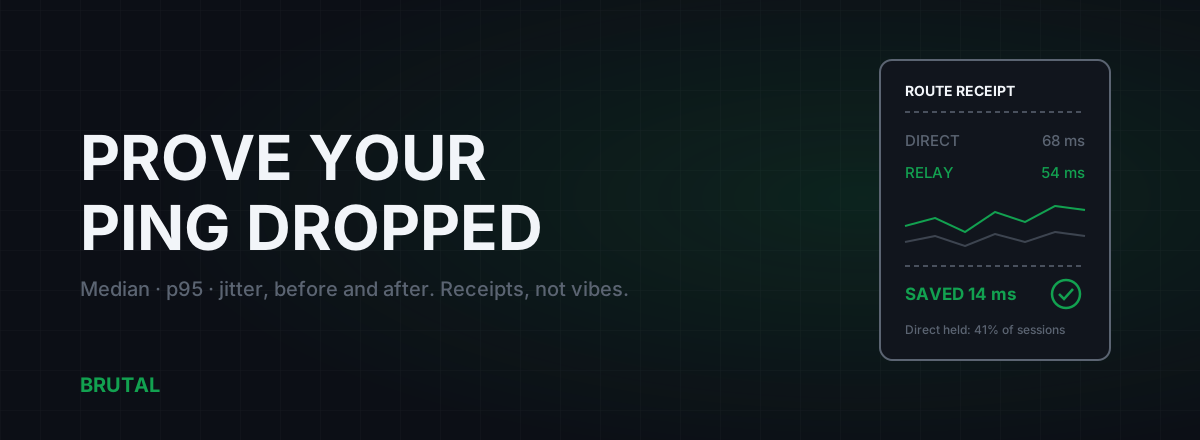
The last piece is the paper trail. Every session ends as a Route Receipt: how many milliseconds the relay saved, or the fact that direct held and the relay stayed out of the way, or that a degrading relay got dropped mid-session. Wins and non-events, recorded with the same weight.
Receipts exist because perceived ping improvement is one of the least reliable feelings in gaming. You install something, you play well for two nights, and your brain writes the success story for you. A written record of measured before-and-after numbers is the antidote. Here's how the receipts measure improvement without flattering anyone.
They also answer the renewal question honestly. If a month of receipts says "Direct won" thirty times out of thirty, you don't need the routing, and the receipts just told you so. That's a strange sales pitch and a very good measurement.
Test the decision on your own connection
Everything above is architecture, and architecture is only worth what it does on your line, in your region, in your game. So test it the way the tool tests itself: baseline first, then compare.
Measure your direct route to the servers you actually play on, at the times you actually play. If your median ping is stable and close to the physical floor for the distance, stop. A relay has nothing to offer you, and an honest tool will spend the month saying "Direct won". If instead you see erratic routing, evening-only spikes that a traceroute places mid-path, or a median far above what the distance justifies, that's a route problem, and route problems are exactly what a relay can sometimes fix. Let the measurement decide, not the marketing. That's the whole design.
Frequently asked questions
Do ping reducers actually work?
Sometimes. They fix exactly one problem: a bad route between your ISP and the game server. On genuinely misrouted or congested paths, savings of 5 to 40 ms are realistic. If your route is already clean, there is nothing to reclaim, and the honest answer is no.
How does a ping reducer know which server my game is using?
The safe way is to read the operating system's connection table, which already lists every process and the remote address it talks to. That's the same information Resource Monitor shows. Tools that inject code or hook the game to find the server are taking a risk they don't need to take.
Why does Smart Route sometimes stay on the direct route?
Because the measurement showed no relay would beat it. Engaging a relay that loses to your direct route would add latency, so the session stays direct and gets recorded as a 'Direct won' receipt. That refusal is the product working, not failing.
Will a ping reducer lower my ping on Wi-Fi?
Rerouting can't fix a radio link. If your spikes come from Wi-Fi interference or a weak signal, no relay will help, because the problem happens before your packets ever leave the house. Run an ethernet cable first, then measure again.
Are ping reducers safe with anti-cheat?
A reducer that works read-only, never touches the game process, and tunnels traffic at the network level looks like a normal VPN to the game. The risky designs are the ones that hook or inject into the game itself. Check how a tool detects the server before you trust it.
Keep reading
 Network & Latency
How to Measure Ping Improvement: Route Receipts, Not Vibes
Single pings lie. Here's the honest way to measure ping improvement: idle vs loaded, median vs p95, jitter, and the per-session receipt any tool worth paying for should show you.
 Network & Latency
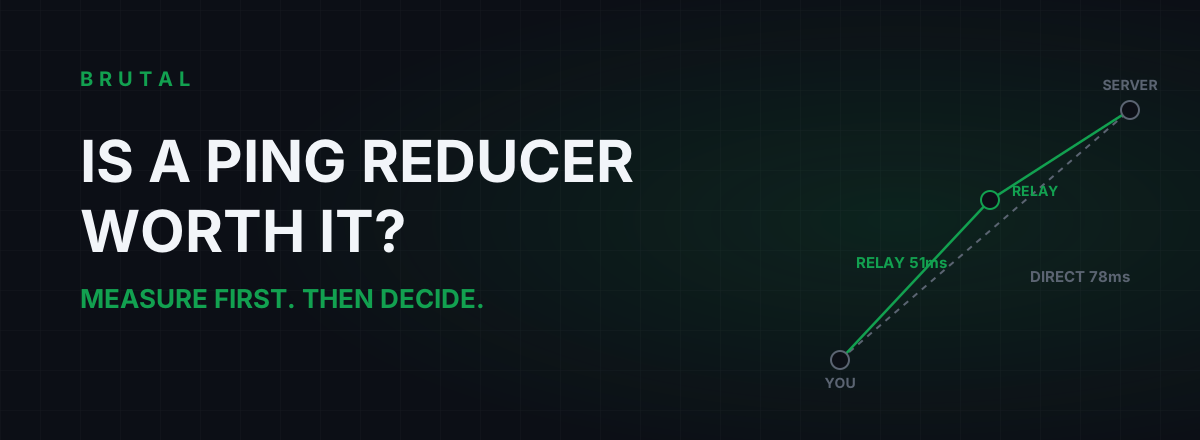
Is a Ping Reducer Worth It? A Decision You Can Test for Free
Most players don't need a ping reducer. Some genuinely do. A free ten-minute measurement tells you which one you are, before any subscription starts.
 Network & Latency
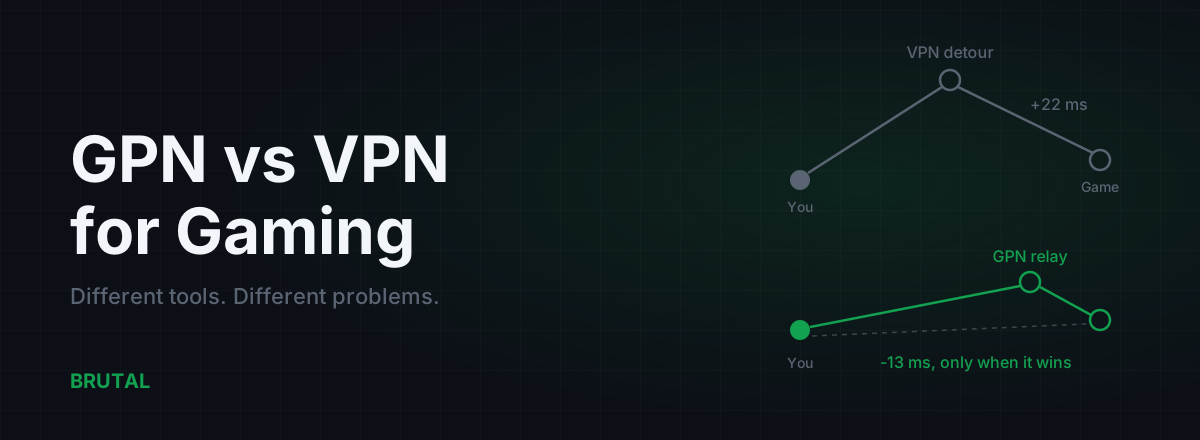
GPN vs VPN for Gaming: They Solve Different Problems
A VPN encrypts all your traffic for privacy and usually adds ping. A GPN reroutes only your game traffic, and only when a measurement says it helps. Here's when each makes sense.
Stop guessing. Measure it.
BRUTAL Optimizer is the honest way to speed up Windows — 17 free modules, a real FPS overlay, verified disk cleanup and drive health. No kernel driver of our own, no game hooks, every setting change reversible.