What Is a GPN? Gaming Private Networks, Honestly Explained
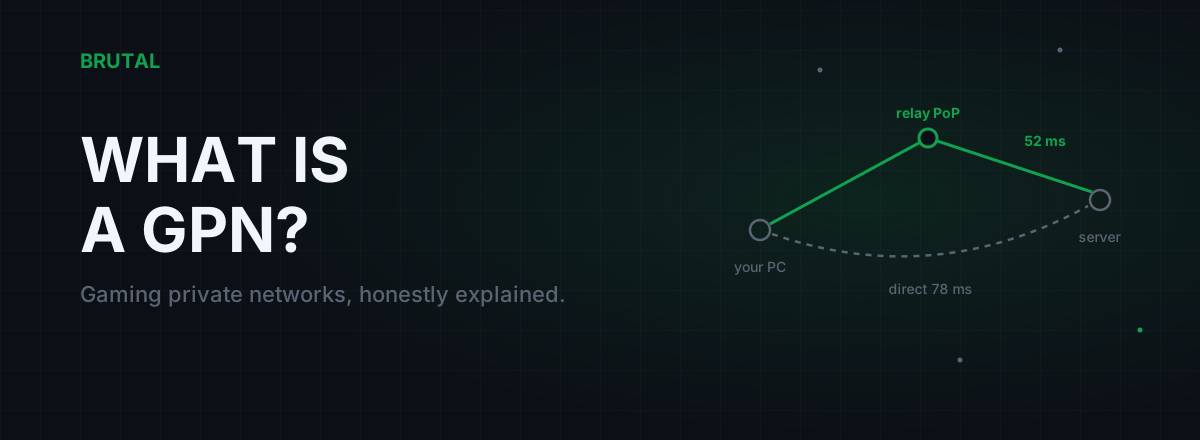
A GPN, short for gaming private network, is a service that reroutes your game's traffic through its own relay servers when that path is faster or more stable than the route your ISP picked. That's the entire trick. It doesn't speed up your PC, it doesn't "boost" packets, and on a connection that's already routed well it does nothing useful at all. What it can do is fix one specific, measurable problem: ISPs sometimes send your packets the long way around, and a well-placed relay can cut the detour.
What is a GPN, exactly?
You'll see the same product under a few names: gaming private network, game route optimizer, ping reducer. Strip the marketing and a GPN is three components working together.
First, a network of relay servers, usually called PoPs (points of presence), placed in or near the datacenter regions where game servers live. Second, a way to identify which of your traffic belongs to the game you're playing right now. Third, a tunnel, almost always WireGuard these days, that carries only that game traffic from your PC to a relay, which then hands it to the game server over the datacenter's own well-connected links.
The word doing all the work is "only". A VPN grabs everything you send. A GPN leaves your browser, Discord, and downloads on the normal path and tunnels just the game. That keeps overhead low and means the rest of your machine behaves exactly as before.
Here's the honest framing: a GPN is a second opinion on routing. Your ISP picked a path to the game server based on its costs and its business deals. A GPN offers an alternative path, and a trustworthy one proves the alternative is actually better before using it.
Why your ISP's route is sometimes bad
The internet doesn't route by distance. It routes by BGP, a protocol where networks announce what they can reach and every ISP picks paths based on peering agreements and transit costs. Milliseconds don't enter the decision. Money usually does.
So real routes do things a map would laugh at. Packets from Chennai to a Singapore game server can bounce through Mumbai first. Traffic from the Gulf to Frankfurt can wander through an exchange in a third country. And during the evening rush, a normally fine interconnect gets congested while your ISP keeps sending traffic through it anyway, because the contract says so. If your ping is clean at 2 PM and ugly at 9 PM, peering congestion is usually the answer.
How much does a bad route cost you? It depends on the detour. A wrong-city exchange might add 15-30 ms. A wrong-continent detour, which genuinely happens on some ISP and server pairs, can add 60 ms or more. You can see it yourself: run a traceroute to your game server and look at where the hops physically sit and where the latency jumps.
How a GPN actually works
Four steps, and each one has a right way and a sketchy way to do it.
Finding the game traffic
The service has to know which connection is the game. The clean way is reading the operating system's connection table: the game process holds an open UDP or TCP session to some server IP, and Windows will report that read-only. No code injection, no hooks, no kernel driver touching the game. That matters, because injecting into a game process is exactly what anti-cheat systems hunt for. Rerouting traffic outside the game is anti-cheat safe; touching the game's memory is not.
Picking the relay
Something has to choose which relay, and the right way is measurement, not a static map. Probe the direct route, probe the candidate PoPs, compare the numbers for your connection at that moment. Routes shift with time of day, ISP maintenance, and peering changes, so a relay that won last night can lose tonight. The decision has to be re-made per session. The sketchy way is a product that assumes its path is better and never checks.
The tunnel
Once identified, game packets get wrapped in an encrypted tunnel to the chosen relay. WireGuard is the standard choice because its overhead is small: a few dozen bytes per packet and near-zero CPU cost on any modern machine. The encryption here isn't a privacy feature. It's just how modern tunnels are built.
The relay
The relay unwraps your packets and forwards them to the game server from inside a datacenter, often the same cloud region the server sits in, over links bought for low latency rather than low price. Your traffic skips your ISP's cheap transit choice. On the way back, the same thing in reverse.
The overhead is real and worth naming: encapsulation plus the relay hop typically costs 1-3 ms. If the relay path isn't meaningfully shorter than direct, you end up slower, not faster. Any GPN that hides this trade-off is selling you something.
GPN vs VPN: what's the difference?
Mechanically they're cousins. Both tunnel traffic to a server you don't own. The differences are purpose and placement, and those matter more than the similarity.
| GPN | VPN | |
|---|---|---|
| What it tunnels | Only the game's traffic | Everything on the device |
| Built for | Lower latency to one game server | Privacy and location change |
| Server placement | Near game hosting regions, picked for latency | Picked for country coverage and privacy law |
| Effect on ping | Lower when your route is bad; slightly worse otherwise | Usually higher; occasionally lower by accident |
| Encryption's job | A transport detail | The entire point |
One practical wrinkle: a VPN moves your apparent location for everything, which can trip store regions, login checks, and matchmaking. A GPN still changes the IP the game server sees, but a sensible one relays you through the same region you'd matchmake into anyway, so nothing about your account context shifts.
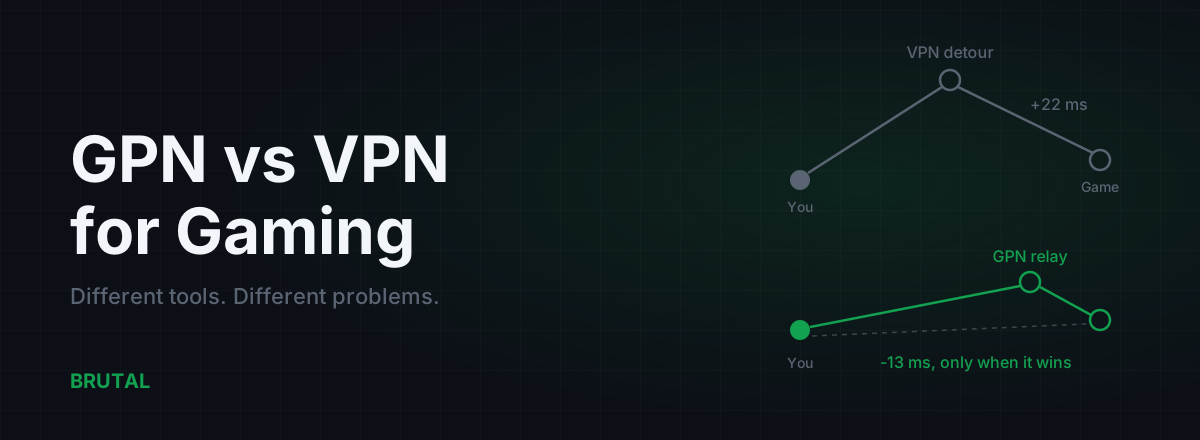
A regular VPN can lower ping now and then, for exactly the same reason a GPN can: it forces a different route, and sometimes different happens to be better. But that's an accident, not a design goal, and it drags all your other traffic along for the ride. If you're weighing the two seriously, the GPN vs VPN comparison goes deeper.
When a GPN actually helps
Four situations come up over and over, and they're all variations of one thing: the direct route is objectively bad.
Bad peering between your ISP and the game's host. Common with smaller ISPs, and in regions where publishers host in one hub that local networks connect to poorly. South and Southeast Asia, the Gulf, and South America see this a lot. The relay enters the game's neighborhood through a front door your ISP doesn't have.
Long international routes. Playing on an EU server from the Middle East, or a Singapore server from an Indian tier-2 city, means crossing several networks. Every handoff is a chance for a cheap detour. One relay near the destination collapses those choices into a single well-run path.
Evening congestion. If your ping climbs every night at the same hour, the problem is often one specific congested interconnect. A relay path can avoid that interconnect entirely, holding steady while direct degrades.
Jitter and route flapping. Sometimes the average ping is fine but the route changes mid-session, or the variance is terrible. A stable relay path can smooth that even when it saves little on average. For aiming and peeking, a steady 60 ms often feels better than a 45 that spikes to 110.
Realistic gains: on genuinely bad routes, 10-40 ms is the honest band, more on truly broken ones. On a decent ISP with a nearby server, most sessions have nothing worth taking, with maybe one session in ten seeing a real win when the network has a bad day. Both outcomes are normal.
When a GPN can't help
This is the part most ping-reducer marketing skips, so let's not.
Physics. Light in fiber covers roughly 100 km per millisecond of round trip. Chennai to Frankfurt is about 7,600 km in a straight line, so that round trip can never dip below roughly 76 ms, and real fiber paths make it 120-140. No relay beats that floor; the good ones just get you closer to it. Work out your own floor before judging any tool against an impossible number.
Your last mile. The tunnel starts at your PC, which means everything between your PC and your ISP is untouched. Wi-Fi interference, an overloaded router, bufferbloat when someone streams 4K, a flaky cable segment: a relay 2,000 km away fixes none of it. Local problems like these cause more ranked losses than routing does.
Routes that are already good. Big city, major ISP, server in the same region: direct is often already near-optimal. Add a relay and you pay the encapsulation tax for nothing. This describes most players in the US and Western Europe on major titles, most of the time.
The server itself. Tick rate, overloaded lobbies, and server-side lag look like ping problems but live entirely on the other end. No route change touches them.
If your route is already good, the best thing a GPN can do is stay out of the way.
Measure before you pay for anything
You can find out which column you're in, "helps" or "can't help", in about twenty minutes, for free.
Ping your game server, or the closest region endpoint, at three times of day: morning, evening peak, late night. Write the numbers down. Then run a traceroute and look for two things: a latency jump between two hops that's bigger than the rest of the path combined, and hop names that place your traffic in the wrong city. Check jitter and packet loss too, not just the average. A clean 50 ms beats a messy 40.
One more check that catches people out: test wired if you can, even once. If your ping over ethernet is 20 ms flatter than over Wi-Fi, no routing product will close that gap, and a cable costs less than any subscription.
The measurement tools in the free BRUTAL Optimizer download cover this without any purchase: ping tests across regions, traceroute with bottleneck detection, a bufferbloat grade, and a DNS benchmark. If everything comes back clean and flat, you don't need a GPN. That's a good result, not a sales failure.
What an honest GPN looks like
The GPN mechanism is legitimate. The market around it is full of nonsense, so here's the standard to hold any product to, including ours.
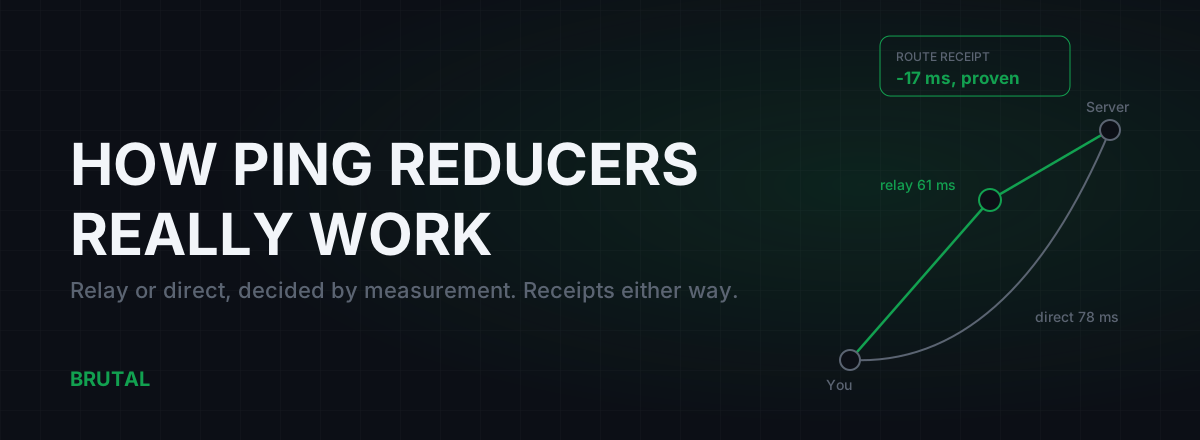
It should measure your direct route against the relay route, for your connection, to your server, at the moment you're playing, and it should engage only when the relay provably wins. Smart Route works this way: it detects the live game connection read-only, measures direct against its relays, and routes through one of its relays only when the numbers say so. When direct wins, it stays direct and records "Direct won" for the session. Every session produces a Route Receipt showing the milliseconds saved, or the plain admission that there was nothing to save. The decision logic is documented, because a routing tool you can't audit is just vibes with a subscription.
Whichever product you pick, the test is the same: can it show you the before-and-after measurement, and will it tell you when it lost? A GPN that never reports "direct was better" isn't winning every time. It's just not telling you.
Frequently asked questions
Is a GPN the same as a VPN?
No. A VPN tunnels all your traffic and is built for privacy; a GPN tunnels only your game's traffic and is built for latency. They share the tunneling mechanism, but the server placement and the purpose are completely different.
How much ping can a GPN actually save?
On a genuinely bad route, 10-40 ms is realistic, sometimes more if your ISP's path is badly broken. On a route that's already good, the honest answer is zero, and the relay would add 1-3 ms of overhead. That's why measuring before engaging matters.
Are GPNs safe to use with anti-cheat?
Rerouting traffic outside the game process is safe; to the game it looks like any other network change. The risk comes from tools that inject code or hook into the game. Prefer services that detect the game connection read-only and never touch game memory.
Do GPNs work for every game?
No, and be suspicious of anyone who claims otherwise. The gain depends on your ISP, your location, and where that game's servers sit. The same GPN can be a big win for one game and useless for another on the same PC.
Is a GPN worth it if my ping is already low?
Usually not for average ping. At 20-30 ms on a nearby server there's little room left to save. The exception is stability: if your low ping spikes during peak hours, a relay path that avoids the congested link can be worth it for consistency alone.
Keep reading
 Network & Latency
GPN vs VPN for Gaming: They Solve Different Problems
A VPN encrypts all your traffic for privacy and usually adds ping. A GPN reroutes only your game traffic, and only when a measurement says it helps. Here's when each makes sense.
 Network & Latency
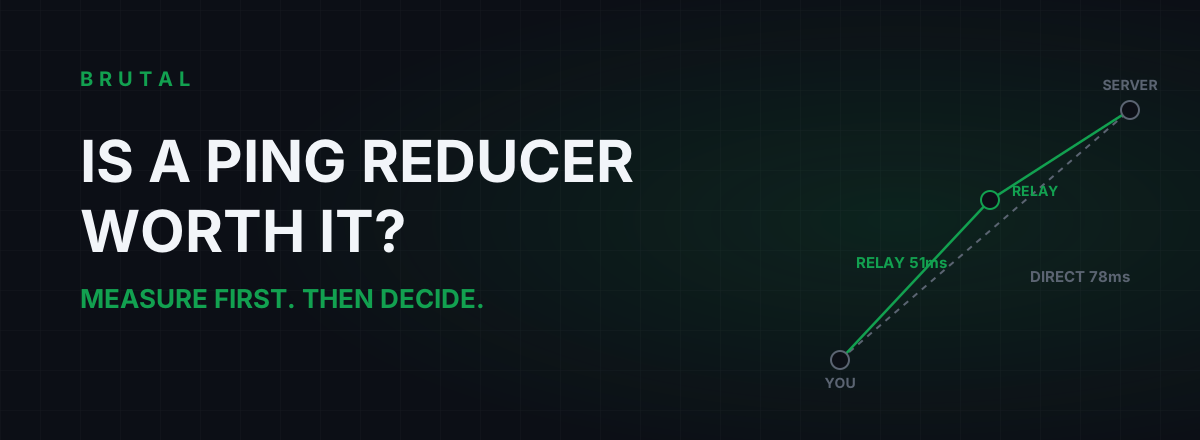
Is a Ping Reducer Worth It? A Decision You Can Test for Free
Most players don't need a ping reducer. Some genuinely do. A free ten-minute measurement tells you which one you are, before any subscription starts.
 Network & Latency
How Do Ping Reducers Work? Relay vs Direct, With Receipts
A ping reducer only helps when a relay path genuinely beats your ISP's route. Here's how Smart Route detects the server, measures both paths, and decides, with a receipt either way.
Stop guessing. Measure it.
BRUTAL Optimizer is the honest way to speed up Windows — 17 free modules, a real FPS overlay, verified disk cleanup and drive health. No kernel driver of our own, no game hooks, every setting change reversible.