Are Ping Reducers Bannable? What Anti-Cheat Actually Sees
Are ping reducers bannable? No, not the kind that work at the network level, which is every legitimate one. A tool that only changes the route your packets take never touches the game process, and the game process is what anti-cheat actually watches. There is one genuinely risky behavior in this space, but it has nothing to do with the routing itself. Here's the whole picture, including the part most vendors skip.
Are ping reducers bannable? The short answer
Anti-cheat has one job: find software that gains an unfair advantage by touching the game. That means code that reads or writes the game's memory, DLLs injected into its process, hooked graphics or input functions, kernel drivers built to hide cheats, and hardware that fakes input. Every serious anti-cheat system, from VAC to Vanguard, is a variation on that theme.
A network-level ping reducer does none of that. It takes packets that were already leaving your PC and sends them down a different set of roads. The game's traffic is identical, byte for byte, at the moment it leaves the game process. The only thing that changes is how long the round trip takes.
The track record backs the theory. WTFast has sold routed game connections since around 2010. ExitLag and NoPing have operated for a decade across the most aggressively policed games on the planet. That's hundreds of millions of sessions, run in plain sight of publishers, with no documented ban wave against any of them. These tools sponsor esports teams and streamers openly. Nobody is hiding anything.
Now the hedge, because you deserve one: no anti-cheat vendor publishes a whitelist saying route optimizers are approved. "Nobody has been banned for this" is observed history, not a signed contract. But the history isn't luck. It follows directly from where these tools sit in your system, and that's worth two minutes to understand properly.
Where a ping reducer actually sits
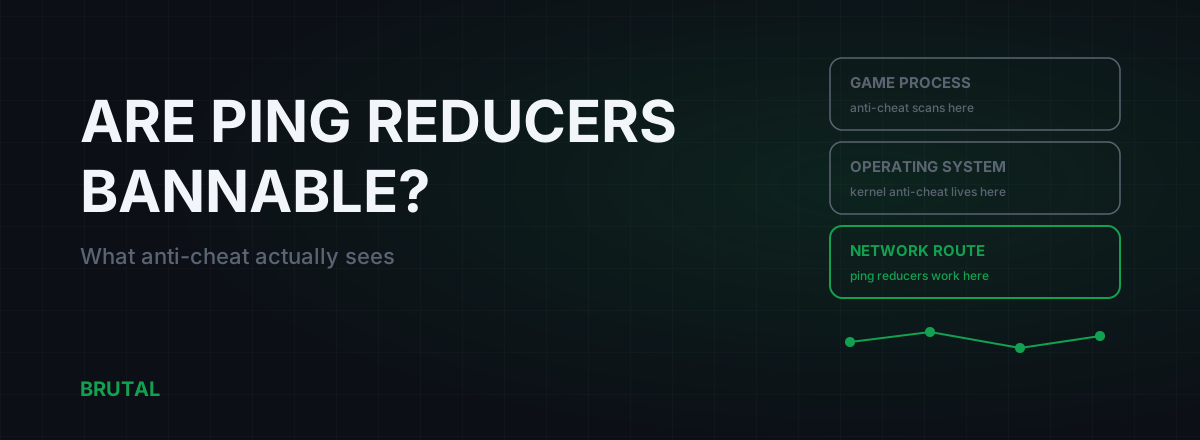
Picture your machine as three layers.
The top layer is the game process: the game's own code plus the anti-cheat module riding along inside or beside it. This is the crime scene anti-cheat cares about. Memory, loaded modules, function hooks, handles that other programs open to it. Everything here gets scanned, some of it constantly.
The middle layer is the operating system: drivers, the kernel, the scheduler. Kernel-level anti-cheat lives here too. Vanguard loads at boot, before you've even thought about opening Valorant, specifically so it can catch cheats that load early.
The bottom layer is the network: your network card, your router, your ISP, and the fifteen-odd routers between you and the game server that you've never seen and will never own. A network-level ping reducer operates here, and only here. Half of its work happens outside your house entirely.
The part that does run on your PC is a virtual network adapter, usually WireGuard. Windows has supported this class of device since the dial-up era, and every corporate VPN on earth installs one. To anti-cheat, a WireGuard adapter is the same kind of object as your Ethernet port: a network device doing network things. There's no category of "suspicious route" to flag, because routes were never yours to begin with. Your ISP changes yours without asking, roughly weekly.
What anti-cheat actually inspects
Take the big four and look at what they actually do.
VAC (Valve) is a user-mode signature scanner. It looks for known cheat code in memory and loaded modules, then bans in delayed waves so cheat developers can't tell what got detected. It never looks at your network path, because a network path isn't a signature.
Vanguard (Riot) is the strictest of the lot: a kernel driver that loads at boot, blocks known-vulnerable drivers, verifies memory integrity, and on Windows 11 leans on TPM and Secure Boot. All that scrutiny points inward, at what runs on your machine. A network adapter passing packets isn't in its threat model. Riot even built its own routing backbone, Riot Direct, because public internet paths to its servers were often bad. The company that built route optimization into its own infrastructure is not going to ban you for wanting the same thing.
Ricochet (Activision) pairs a kernel driver that runs during play with heavy server-side behavior analysis. The server-side half looks at what your account does: aim patterns, stats, reports. Your route contributes exactly one number to that picture, your latency, which millions of legitimate players vary on wildly.
Easy Anti-Cheat and BattlEye cover most of the rest of the market. Kernel drivers watching for injection, hooking and file tampering. Same story.
Notice what's missing from all four. None of them inspects which routers your packets crossed. They couldn't if they wanted to: the internet doesn't expose "the route" as a property an endpoint can audit, and it changes on its own all the time.
| Anti-cheat | Where it runs | What it hunts | Does routing touch it? |
|---|---|---|---|
| VAC (CS2, Steam games) | User mode | Known cheat signatures in memory and modules | No |
| Vanguard (Valorant, LoL) | Kernel, from boot | Vulnerable drivers, memory tampering, injection | No |
| Ricochet (Warzone, CoD) | Kernel + server side | Injection, hooks, statistical anomalies | Only as a latency number |
| EAC / BattlEye (Apex, Fortnite, PUBG) | Kernel | Injection, hooking, file tampering | No |
Why publishers tolerate route optimizers
Three reasons, in descending order of importance.
First, banning "your packets took an unusual path" would ban half the internet. University networks, office VPNs, CGNAT ISPs that route entire cities through one exit point, Starlink bouncing you through a ground station three states away, mobile carriers tunneling everything through regional gateways. There's no clean line between "route optimizer" and "how the internet normally works," so no vendor tries to draw one.
Second, lower latency by legitimate means isn't cheating, and publishers have never treated it as cheating. It's the same advantage you'd get by moving closer to the server or paying for a fiber line. It's also smaller than people assume; latency helps, but tick rate and netcode decide how much of it you actually feel.
Third, the industry itself runs on optimized routes. Riot Direct exists. Esports events run on private circuits. Publishers understand better than anyone that the public internet routes game traffic badly, because they field the complaints when it does.
Anti-cheat doesn't care how your packets traveled. It cares what's running next to the game.
One nuance for completeness: a few games block logins from known datacenter IP ranges, usually to fight fraud and ban evasion. When that happens, the relay simply fails to connect. Blocked is not banned, and publishers keep those responses deliberately separate.
The ToS fine print, read honestly
Most game terms of service contain a clause banning "network manipulation" or "interfering with the network to gain an advantage." Read it in context and it's clear what that language was written for: lag switching, where a player deliberately induces packet loss so they teleport through firefights while everyone else stutters. Making your connection deliberately worse to abuse lag compensation is cheating, it's detectable, and it's bannable everywhere. Making your connection better is the opposite of that, and no major publisher has ever prosecuted it under those clauses.
The clause that does matter is about location. Riot's terms prohibit misrepresenting your region. Tencent and Garena carry similar language for PUBG Mobile and Free Fire. These clauses exist because region matters, to matchmaking fairness and to region-locked economies, and people abuse relays to fake it.
Practical advice: if you're the cautious type, search your game's current terms for "VPN" and "proxy" before you pay for anything. It takes three minutes and beats trusting a blog post, including this one. Terms change. Architecture doesn't.
The one thing that actually gets accounts banned
Region spoofing for matchmaking abuse. Using a relay or VPN to appear in another region so you get easier lobbies, farm rank against weaker players, or claim region-locked rewards. PUBG Mobile and Free Fire have both run ban waves that swept up VPN users doing exactly this.
Note carefully what got detected. Not the VPN. The behavior. Detection is server-side and behavioral: an account's IP history jumping continents in an hour, a claimed region that doesn't match the latency fingerprint, reward events claimed from a country the account has never touched. The routing tool was the enabler; the abuse was the offense. A player who routes to the same server they'd play on anyway generates none of those signals.
The second trap wears the same costume: "free ping booster" apps that aren't network tools at all. On mobile, GFX tools that edit the game's config files to unlock frame rates. On Windows, apps that inject overlays or "optimize" the game's memory while claiming to fix your ping. File modification and process injection are precisely what anti-cheat scans for, and PUBG Mobile has banned GFX tool users in waves. If a "ping" app wants access to the game's files or process, it isn't a ping tool, and most free booster apps fail exactly this test.
How to vet any ping reducer in 60 seconds
You don't need to trust anyone's marketing, ours included. Check the architecture.
Good signs: it installs a VPN-style network adapter and nothing else. It never asks where your game is installed. It works whether or not the game is running. It shows measured before-and-after numbers so you can verify it's doing anything at all, which matters, because a relay only helps when your ISP's route is genuinely bad, maybe one connection in three depending on where you live and what you play.
Red flags: it asks to inject, hook or overlay the game. It offers to "patch" or "optimize" game files. Its marketing promises easier lobbies, region switching or matchmaking tricks. It claims guaranteed ping reduction for every game, which is physically impossible and tells you the vendor is comfortable lying to you about other things too.
If you want the deeper background on the category, here's what a GPN actually is and how it differs from a regular VPN for game traffic.
Where Smart Route stands on all this
Smart Route was built to stay on the boring side of every line in this article. It finds the game's server connection by reading the connection table Windows already publishes to any program that asks: read-only, no injection, no hooks, no kernel driver. The routing itself runs over standard WireGuard, the same technology inside mainstream VPNs, through our own relays. And it routes you to the server your game already chose. It won't move your region, and it won't pretend that's a feature we forgot to build. It's left out on purpose.
It also refuses to route when routing doesn't help. Before engaging, it measures your direct path against the relay and only switches on a proven win; otherwise you stay direct and the session gets recorded as "Direct won." Here's exactly how that decision works. The measurement tools, ping test, traceroute, bufferbloat grade and DNS benchmark, are all free in the download. Routing is the paid part; the pricing is on the Smart Route page.
The general rule stands, for our tool or anyone's: the moment a "ping reducer" asks for more access than a network adapter, close the installer. Your packets need a better road, not a passenger.
Frequently asked questions
Can VAC ban you for using a ping reducer or VPN?
No. VAC is a user-mode scanner that looks for known cheat code in the game's memory and loaded modules. A routed connection changes none of that. Steam can separately restrict accounts that use VPNs to fake their store region for cheaper prices, but that's a store policy, not a VAC ban.
Is it safe to use ExitLag or WTFast with Valorant's Vanguard?
There's no documented case of Vanguard banning anyone for a route optimizer, and these tools have run alongside it since launch. Vanguard hunts vulnerable drivers and memory tampering, not network adapters. The honest caveat: Riot publishes no whitelist, so this is track record plus architecture, not a written guarantee.
Can you get banned for using a VPN in PUBG Mobile or Free Fire?
Not for lowering ping to your own region's server. The ban waves in both games targeted region hopping: using a VPN to enter easier lobbies or claim region-locked rewards. That abuse is detected server-side through IP history and latency mismatches, regardless of which tool enabled it.
Do ping reducers count as cheating?
No publisher treats lower latency by legitimate routing as cheating. It's the same class of advantage as a better ISP or living closer to the server. What does count is lag switching, deliberately degrading your connection to abuse lag compensation, and that's bannable everywhere.
Are free ping booster apps safe to use?
Many aren't. A lot of free boosters, especially mobile GFX tools, edit game files or inject into the game process, which is exactly what anti-cheat scans for. PUBG Mobile has banned GFX tool users in waves. If it needs access to the game's files, it isn't a network tool.
Keep reading
 Network & Latency
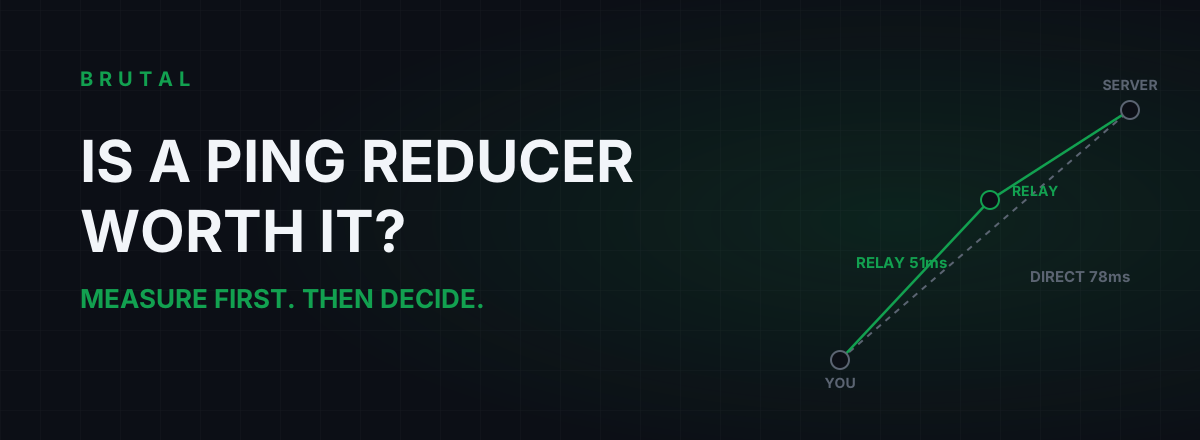
Is a Ping Reducer Worth It? A Decision You Can Test for Free
Most players don't need a ping reducer. Some genuinely do. A free ten-minute measurement tells you which one you are, before any subscription starts.
 Network & Latency
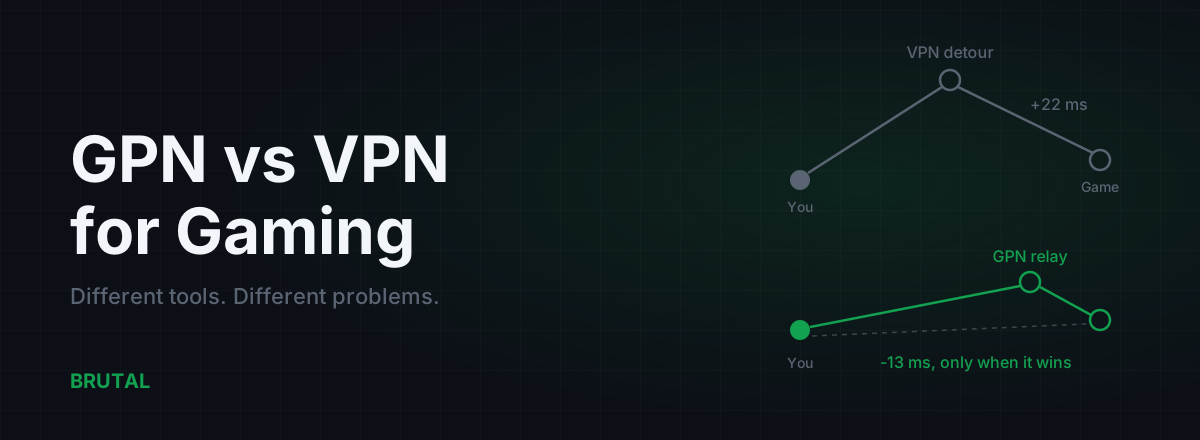
GPN vs VPN for Gaming: They Solve Different Problems
A VPN encrypts all your traffic for privacy and usually adds ping. A GPN reroutes only your game traffic, and only when a measurement says it helps. Here's when each makes sense.
 Network & Latency
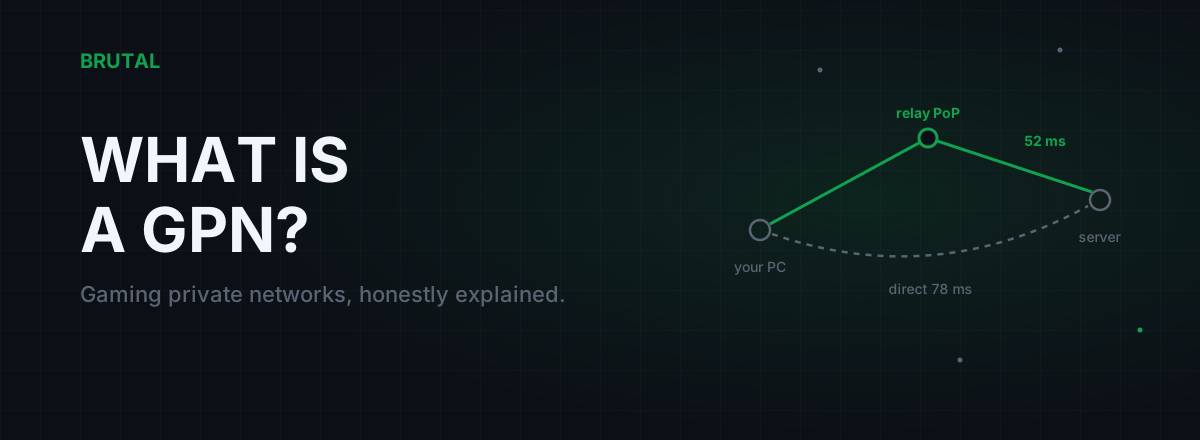
What Is a GPN? Gaming Private Networks, Honestly Explained
A GPN reroutes only your game's traffic through relay servers when that path beats your ISP's route. Here's how it works, when it helps, and when physics says no.
Stop guessing. Measure it.
BRUTAL Optimizer is the honest way to speed up Windows — 17 free modules, a real FPS overlay, verified disk cleanup and drive health. No kernel driver of our own, no game hooks, every setting change reversible.