Do Ping Boosters Actually Work? Why Ours Tells You No
Do ping boosters actually work? Sometimes. On most connections, most nights, the direct route your ISP already gives you is the fastest path that physically exists, and an honest tool should look at the numbers and tell you no. The interesting question isn't whether ping boosters ever work. It's whether the one you're looking at will admit it when it doesn't.
Do ping boosters actually work? The honest distribution
A ping booster, ping reducer, GPN, whatever the label, does one thing: it reroutes your game traffic through a relay server sitting on a network with better paths than your ISP's. That's it. It can't compress distance, it can't make your Wi-Fi stop dropping packets, and it can't speed up an overloaded game server. It can only take a different road.
So the real question is how often the different road is actually faster. Based on what measured sessions show, here's the rough shape of it. If you're in a well-served region playing on a nearby server, a relay wins maybe one session in ten, often fewer. When it wins, the typical saving is 5 to 15ms. If your ISP's route to that game is genuinely broken, say it sends your Mumbai traffic through Singapore before coming back, the win can be 20 to 60ms and it feels like a different game. Those cases are real. They're also the minority.
Which means the correct output of a ping booster, most of the time, is "stay direct, I have nothing for you tonight." A tool that reports wins every session, on every game, isn't beating physics nine times out of ten. It's measuring something else, or measuring nothing.
If you want the pure buying-decision version of this question, we wrote it up separately in is a ping reducer worth it. This article is about something that comes first: how to tell whether any tool in this category is telling you the truth.
Why direct usually wins
Two reasons, one physical and one economic.
The physical one: latency is mostly distance. Light in fiber covers roughly 200km per millisecond, so a 2,000km round trip has a hard floor around 20ms no matter what software you run. A relay adds at least one extra hop plus a little processing time. For the detour to win, your ISP's path has to be worse than the detour by more than the detour costs. That's a specific failure, not a default condition.
The economic one: game publishers aren't careless about this. They host at well-peered data centers precisely so the majority of players get a clean route, because laggy players quit. Your ISP, meanwhile, has a direct commercial incentive to reach big destinations efficiently. The boring result is that the default path from your house to a major game server is usually within a few milliseconds of the theoretical floor.
Usually. Not always. ISPs make cheap transit decisions, peering disputes happen, and a route that's fine at 2pm can melt at 9pm when the whole neighborhood starts streaming. That gap is where ping boosters live, and it's a real gap. But it's a gap, not the landscape.
If a ping reducer never tells you no, it isn't measuring your connection. It's decorating it.
When a relay genuinely helps
The wins cluster around a few specific situations:
- Bad peering. Your ISP and the game's host network don't exchange traffic anywhere near you, so your packets travel hundreds of extra kilometers to a distant exchange point. A relay that hands traffic to a better-connected network close to you cuts the detour out.
- Evening congestion. The route is fine all afternoon and 30ms worse at night because one transit link is saturated. This is the classic evening lag pattern, and a relay that goes around the jammed link genuinely helps during those hours and does nothing the rest of the day.
- Cross-border play. International transit is where ISPs cut costs hardest. If you live in one country and play on a server in another, the odds of a wasteful path go up a lot.
- Loss and jitter, not average ping. Sometimes the relay's average latency matches direct but the path is cleaner: fewer dropped packets, steadier timing. That's a legitimate win for how the game feels, but only a tool that measures more than a single ping number will ever detect it.
Notice what all four have in common. They're conditions of your specific connection, to a specific server, at a specific time. That's why blanket claims are structurally incapable of being true. Nobody, including us, knows whether a relay will help you until something measures you.
The tell: a tool that never says no
Here's the uncomfortable arithmetic for this product category. If direct wins most sessions, an honest routing tool spends most of its life doing nothing visible. That's a hard thing to charge money for, so a lot of the industry solved it the other way: make the tool look busy.
The standard moves:
- The permanently green overlay. An "optimized" badge that lights up the moment you connect and never reflects a measurement. It's a UI state, not a result.
- Measuring the wrong leg. Showing you ping to the tool's own relay instead of end-to-end ping to the game server. The first number is small and meaningless. The second is the only one your matches feel.
- Before-and-after theater. Comparing your ping at different times of day, or comparing an artificially bad "before" against a normal "after". Congestion varies hour to hour, so this trick writes itself.
- Bundled placebo. A "boost" button that clears RAM and flushes DNS as if that changed your route. Closing Chrome does not move your packets onto different fiber.
What an honest receipt looks like
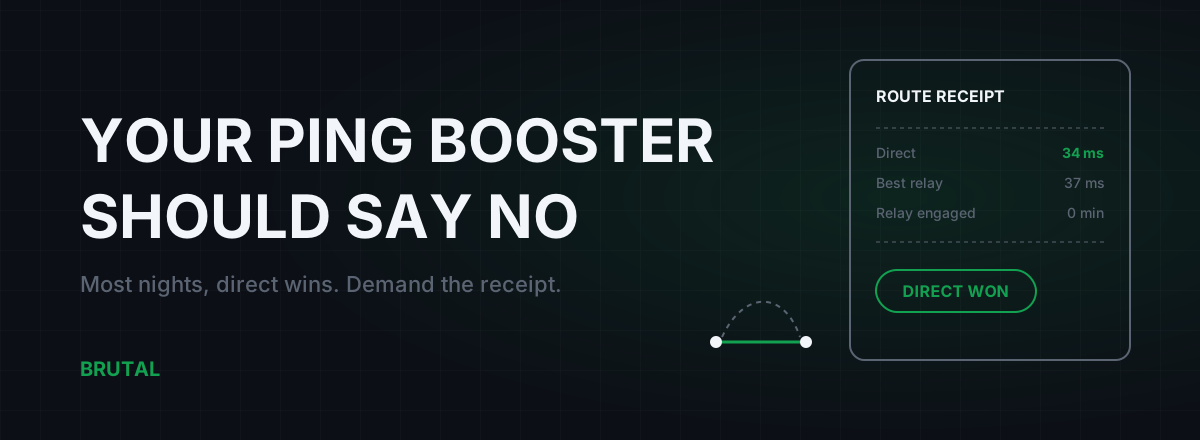
The fix for all of that is boring: write everything down. If a tool measures direct against relay for your live connection and engages only when the relay wins, then every session produces a verifiable record. We call these Route Receipts, and the most important kind is the one that says the tool did nothing.
Read the receipt above. Direct to the Mumbai server was 34ms. The best relay was 37ms. So the relay never engaged, and the session went into the book as "direct won." Zero milliseconds saved, and it says so.
That looks like failure until you see what it buys you. Because the tool provably says no on losing nights, its yes means something. When the same receipt book shows "relay engaged, saved 18ms" next Tuesday at 9pm, you can trust that number, because you've watched the tool decline wins it didn't have. There's a longer piece on how route receipts measure real improvement if you want the mechanics.
You don't need our product to use this principle. Whatever tool you're evaluating, ask: where's the record? Can I see the sessions where it chose not to route me? If every entry in the history is a win, you're not looking at history. You're looking at advertising.
How to audit any ping booster in ten minutes
Run these questions against anything in this category before paying, ours included:
| Question | Honest tool | Theater |
|---|---|---|
| What does it measure? | Direct vs relay to your actual game server, per session | Ping to its own relay, or nothing at all |
| Does it ever decline? | Stays direct and records it when the relay loses | Always "boosted", always green |
| Can you see history? | Per-session records, including the losses | One lifetime "improvement" number with no sessions behind it |
| What does it claim? | Hedged ranges tied to conditions | Lower ping in every game, guaranteed |
| What else is in the button? | The route, and only the route | RAM cleaning, FPS boost, and registry magic in the same click |
Then run one practical test that costs nothing. Same game, same server, same hour: one session with the tool on, one with it off, watching the in-game ping readout rather than the tool's own overlay. The game's number is the ground truth, and a real product survives being checked against it. Ten minutes, and you'll know more about whether ping boosters actually work on your connection than any review can tell you.
Why we built one that says no
Smart Route is our entry in this category, and its defining feature is refusal. It watches which server your game is actually talking to, read-only, with no injection, no hooks, and no kernel driver. It measures your direct path against our relay network, which runs from Tokyo to Sao Paulo, and it engages a relay only when the measurement shows a real win for your connection at that moment. Otherwise it stays out of the way and writes "direct won" into the receipt book. The decision logic is documented in how Smart Route decides between relay and direct, because a routing decision you can't inspect is just vibes with extra steps.
Honest limits, stated plainly. It can't beat the speed of light, so if your route already sits near the distance floor there's nothing to save. It can't fix packet loss inside your house, a saturated Wi-Fi channel, or a game server buckling under load. And on plenty of connections it will spend most nights holding direct. That's the design working.
The measurement side is free. Ping tests, traceroute, a bufferbloat grade, and a DNS benchmark all ship in the free download, so you can find out whether your routes are even broken before spending anything. If the measurements say your paths are clean, don't pay us. That isn't modesty. It's the same measurement the paid tier runs, so you'd only be buying a stack of "direct won" receipts.
Fix the free stuff first
One last thing, because it's where most "high ping" complaints actually live. The majority of lag we see isn't a routing problem at all, and no relay on earth will touch it.
Wi-Fi is the biggest offender. A flaky wireless link adds jitter and loss that feels exactly like server lag, and a cable beats Wi-Fi for latency stability in almost every setup. Second is bufferbloat: your router letting someone's cloud backup queue up in front of your game packets, adding 100ms or more to everything. Read up on what bufferbloat is, then grade your line with the vendor-neutral Waveform bufferbloat test. Both problems are fixable for free, and both make any ping booster look useless because the damage happens before your traffic ever reaches a route.
So, do ping boosters actually work? When your routing is broken, yes, measurably, and sometimes by a lot. The rest of the time the correct answer is no, and the whole trick to buying in this category is picking a tool that's willing to say so. Demand the receipts. Especially the ones where the tool loses.
Frequently asked questions
Do ping boosters work for every game?
No, and they can't. A ping booster only helps when your ISP's route to that specific game server is worse than the relay's path, which depends on your ISP, your city, the server region, and the time of day. The same tool can win for one player and do nothing for their friend across town. Claims like 'works in 500+ games' describe compatibility, not results.
How much ping can a ping booster realistically save?
When it wins at all, typically 5 to 15ms. On genuinely broken routes, usually cross-border play or bad ISP peering, wins of 20 to 60ms happen and feel dramatic. On a clean route there's nothing to save, and an honest tool stays direct rather than inventing a number.
Are ping boosters safe with anti-cheat?
Network-level routing that never touches the game process is the safe pattern, and it's how reputable tools work. The risky designs are the ones that inject overlays or hooks into the game itself. Smart Route detects your game's server connection read-only and reroutes at the network layer, with no injection, no hooks, and no kernel driver.
Why does my ping booster show a lower ping than the game does?
It's probably showing latency to its own relay server, not end-to-end latency to the game server. The first number is small and meaningless because your packets still have to travel from the relay to the game. The in-game ping readout is the number your matches actually feel.
Should I use a ping booster on Wi-Fi?
Fix the Wi-Fi first. Wireless jitter and packet loss look exactly like lag but happen inside your house, before your traffic reaches any route a relay could change. Plug in a cable or fix the link, then measure whether you still have a routing problem at all.
Keep reading
 Network & Latency
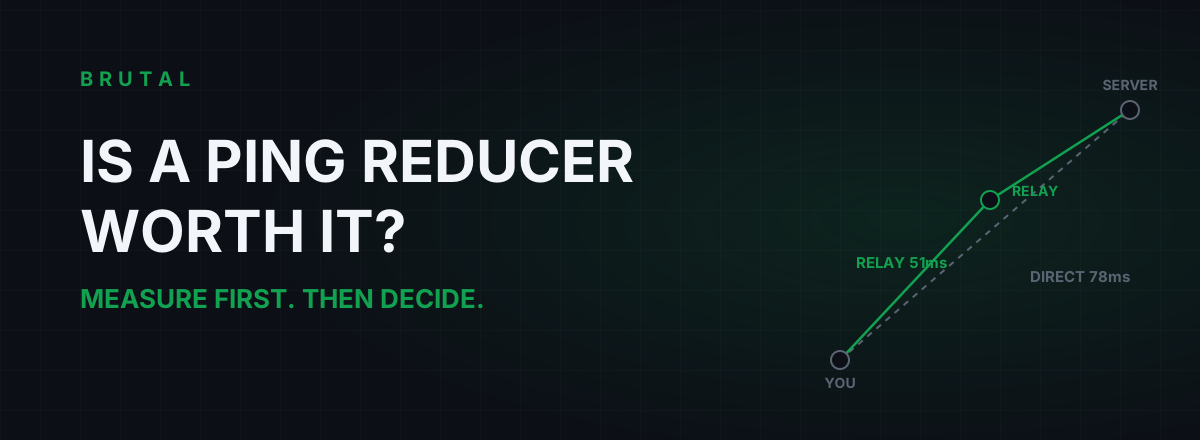
Is a Ping Reducer Worth It? A Decision You Can Test for Free
Most players don't need a ping reducer. Some genuinely do. A free ten-minute measurement tells you which one you are, before any subscription starts.
 Network & Latency
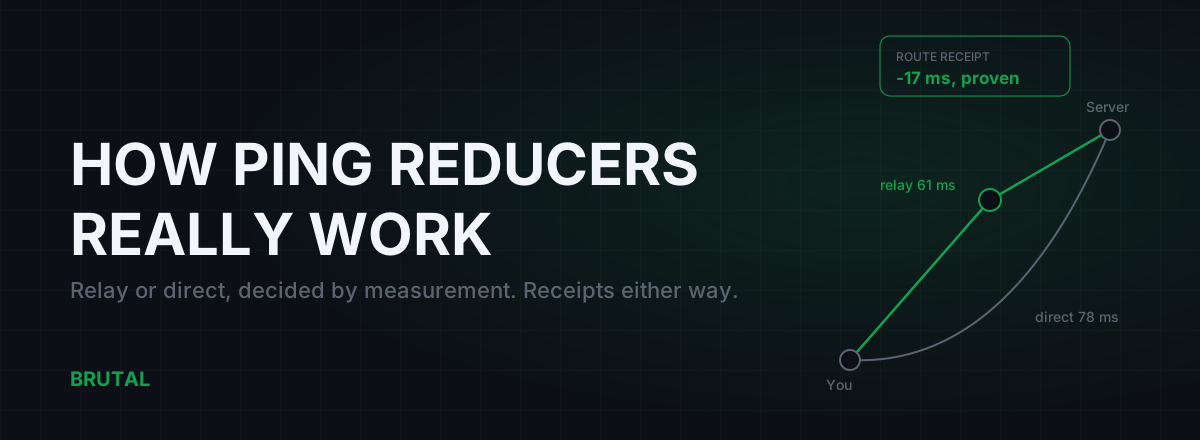
How Do Ping Reducers Work? Relay vs Direct, With Receipts
A ping reducer only helps when a relay path genuinely beats your ISP's route. Here's how Smart Route detects the server, measures both paths, and decides, with a receipt either way.
 Network & Latency
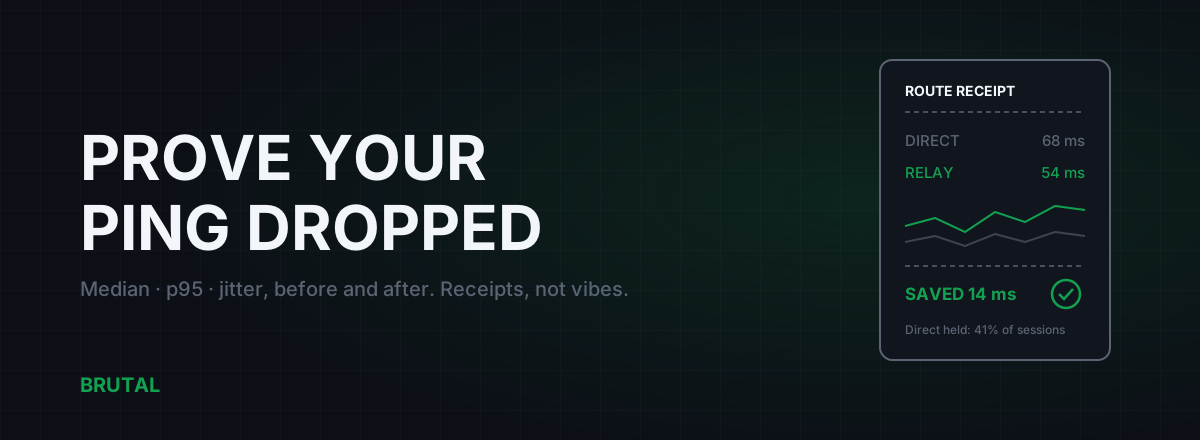
How to Measure Ping Improvement: Route Receipts, Not Vibes
Single pings lie. Here's the honest way to measure ping improvement: idle vs loaded, median vs p95, jitter, and the per-session receipt any tool worth paying for should show you.
Stop guessing. Measure it.
BRUTAL Optimizer is the honest way to speed up Windows — 17 free modules, a real FPS overlay, verified disk cleanup and drive health. No kernel driver of our own, no game hooks, and per-module undo for the settings it changes.