ExitLag Alternatives in 2026: An Honest Comparison
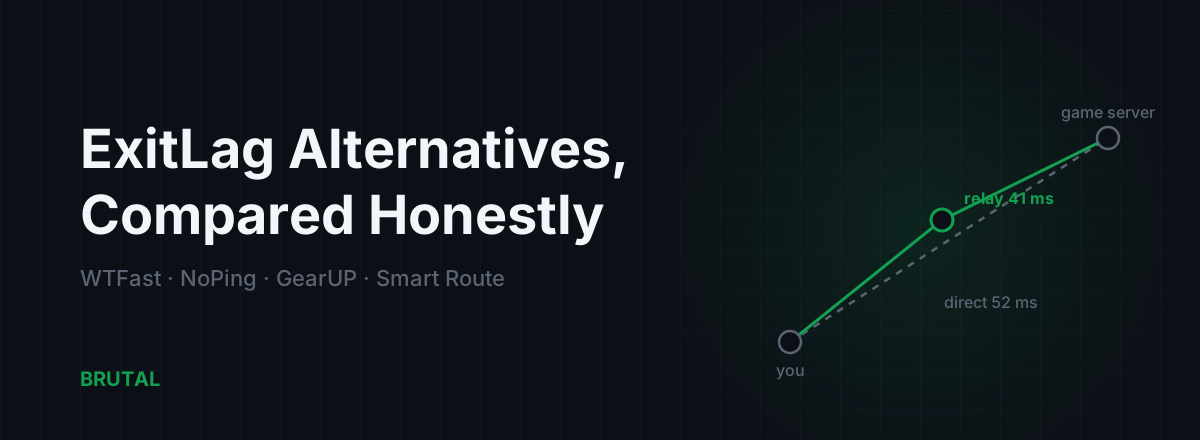
Most ExitLag alternatives do the same core thing ExitLag does: route your game traffic through a private relay network and hope the relay path beats the default route your ISP chose. Sometimes it genuinely does, mostly on congested evening routes or badly peered ISPs. On a clean fiber line to a nearby server, it usually doesn't. This guide compares WTFast, NoPing, GearUP Booster and our own Smart Route on the criteria that predict whether you'll actually see lower ping, not on whose game list is longest.
One thing up front: we build Smart Route, so we have skin in this game. We've tried to keep this criteria-first and fair, and we'll tell you where a competitor is plainly stronger than we are. Judge accordingly.
What ExitLag does well
ExitLag earned its position, so credit first.
The game list is enormous. Over a thousand supported titles, each with pre-mapped server regions. You pick your game, pick a region, and it routes. Nobody else in this space matches that breadth, and if you rotate through a dozen games a month, the convenience is real.
Multipath is genuinely clever engineering. ExitLag can send duplicate copies of your game packets down several routes at once. Whichever copy arrives first wins, and the rest get discarded. That doesn't lower your best-case ping, but on a route that's dropping packets it smooths out the loss noticeably. You pay for it in upload bandwidth, which is a fair trade on most home connections.
It's also mature software. The product has been around since roughly 2017, the client is stable, and the relay network is large across the Americas and Europe. If ExitLag works for you and the price feels fair, switching for its own sake buys you nothing. This article is for the people it isn't working for, or who could never prove it was.
Why people look for ExitLag alternatives
Four reasons come up again and again.
You can't prove it's doing anything. ExitLag shows an estimated improvement when you pick a route, but once you're in the match you're going on feel, and feel is unreliable. A 6ms improvement is invisible. A placebo feels the same as a small win. If you're paying monthly, you deserve a per-session record of what the tool actually changed, which is why we care so much about measuring ping improvement properly.
The subscription stacks up. As of this writing, ExitLag runs roughly six to seven US dollars a month, less on longer plans. That's fair for a tool saving you 30ms every evening. It's a bad deal for a tool that helps two nights a month, and without session records you can't tell which one you bought.
The PoPs may not fit your route. Relay networks only help when there's a relay near you, a relay path toward the game server, and a better route between them than your ISP offers. Coverage that's dense in Brazil and the US doesn't automatically help someone in Chennai playing on Mumbai servers. Where the relays sit matters more than how many there are.
It was bought for the wrong problem. No relay network can fix packet loss on your own Wi-Fi, bufferbloat on your router, or an overloaded game server. Going by the complaints you'll find on any forum, a decent share of unhappy ping-reducer customers, maybe a third, have a local problem that no alternative will fix either.
What to compare in an ExitLag alternative
Every marketing page in this category says the same three things: more servers, more games, less lag. Here's what actually separates the tools.
Measurement honesty. Does the tool measure your direct route against its relay route, on your connection, before claiming a win? A relay can add latency just as easily as it removes it. The single most useful feature in any ping reducer is the willingness to say no, and we'd apply that test to our own product first.
Session receipts. After you play, can you see what happened? Milliseconds saved, sessions where direct won, loss before and after. If a tool keeps no history, every renewal is a leap of faith.
PoP geography for your route. Count only the PoPs that matter to you: one near your city, one near your game's server region. Twenty PoPs in the wrong hemisphere are worth less than two in the right one.
Trial and refund terms. Routes degrade in the evening, not at 11am on a Tuesday. A useful trial has to be long enough to cover several peak-hour sessions on your actual game.
Anti-cheat approach. Network-level routing, where the game just sees a normal internet path, has a long clean record with anti-cheat systems. Anything that injects into the game process is a different risk class entirely. All five tools discussed here route at the network level.
If a tool never says "direct won", it isn't measuring. It's marketing.
WTFast
WTFast is the oldest brand in the category. It coined the term GPN and was routing game traffic before most competitors existed. Strengths: a long track record, per-game route control, and wide coverage in North America and Southeast Asia.
The honest caveats: pricing tends to sit at the higher end of the category, reported results vary a lot by region, and the client exposes less route evidence than we'd like. It's more "connected, trust us" than per-session proof. If you're in NA or SEA and ExitLag's routes never suited you, it's a reasonable trial. Just run the numbers yourself during that trial rather than trusting the connection screen.
NoPing
NoPing is, like ExitLag, Brazilian, and the two have competed head to head in South America for years. It supports a large game list, usually undercuts ExitLag on price, and its South American coverage is excellent. It also offers a multi-route feature in the same spirit as ExitLag's multipath.
Caveats: the in-app before/after numbers are estimates rather than an audited log, and coverage outside the Americas and Europe is thinner. If you play from LATAM and want to pay less than ExitLag charges, this is probably the first alternative to trial. Elsewhere, check the server list against your actual route before you bother installing.
GearUP Booster
GearUP Booster is the mobile-first option, popular across Asia for mobile shooters like PUBG Mobile and Free Fire, with a desktop client as well. Among ExitLag alternatives it's often the practical pick for phone players, simply because most of this category is desktop-first.
Caveats: the marketing is the most aggressive on this list, and route evidence is thin; you mostly get a boost animation and a number without a clear methodology behind it. Results on mobile are also tangled up with your Wi-Fi and carrier conditions, which no booster controls. If you're a mobile player in Asia, trial it against a week of baseline measurements and let the numbers decide.
Smart Route (ours, so read accordingly)
Smart Route is BRUTAL Optimizer's GPN, and it makes a different bet from everything above: the measurement is the product. It detects the live game's server connection read-only, with no injection, no hooks and no kernel driver. It then measures your direct route against its relay candidates on your actual connection, and routes only when the relay provably wins. When direct wins, it stays direct and writes "Direct won" on your Route Receipt, the per-session log of milliseconds saved, direct holds and blocked routes.
The honest trade-offs, because every tool has them. Our relay footprint (Singapore, Tokyo, Frankfurt, Chennai, Bangalore, Delhi, Jakarta, Sao Paulo, Dallas, Bahrain) is smaller than ExitLag's network. There's no packet-duplication mode like ExitLag's multipath, so loss on a path we can't route around is loss we can't fix. And because game support works by detecting the live connection rather than a hand-curated list, you don't get per-game preset pages; you get whatever your game actually connects to.
Coverage is strongest on Indian and Asian routes. If you're playing from rural North America to a Virginia server, the PoP math may simply never favor a relay, and Smart Route will keep you direct and say so rather than routing anyway. Some people find that honesty refreshing. Some find it annoying to pay for a tool that keeps saying no. We think saying no is the feature.
The measurement tools (ping test, traceroute, bufferbloat grade, DNS benchmark) are free in the free download. Routing is paid; see the pricing on the Smart Route page. For a closer look at how it stacks up against the two biggest names, we wrote a three-way comparison.
Side by side
| Tool | Standout strength | Proof vs direct | Will it say "stay direct"? | Best fit |
|---|---|---|---|---|
| ExitLag | Biggest game list; multipath duplication | Estimates, no session audit | No | Multi-game players; Americas and Europe |
| WTFast | Longest track record; per-game control | Limited route stats | No | NA and SEA routes |
| NoPing | Price; South American coverage | In-app estimates | No | LATAM players on a budget |
| GearUP Booster | Mobile-first; Asia coverage | Thin | No | Mobile shooter players in Asia |
| Smart Route | Measures every session; Route Receipts | Yes, direct vs relay each session | Yes, records "Direct won" | Indian and Asian routes; anyone who wants proof |
Feature sets and prices shift. Verify against the current versions before you pay anyone, including us.
How to test any alternative fairly
Every tool here gives you some way to test before you commit, whether that's a trial, a refund window or free measurement. Treat it like an experiment, not a vibe check.
A few details make the test honest. Use the in-game ping and network stats, not the number in the booster's own window; the game's counter is the one your matches are played on. Test at your real play hours, because routes that are fine at noon fall apart at 9pm. Watch jitter and loss, not just average ping, since a stable 45ms usually feels better than a bouncy 38ms. And rule out your own equipment before crediting or blaming any relay: run a bufferbloat check like Waveform's test, and if your line grades C or worse, fix that before concluding anything about routing.
If you're unclear on what separates these tools from a normal VPN, the short version is that a VPN routes everything through one privacy-focused server while a GPN routes only your game through latency-picked relays. The longer version is in our GPN vs VPN comparison.
The honest bottom line. ExitLag is a good product with the category's usual blind spot: it can't prove to you, session by session, that it helped. If you're in the Americas, trial NoPing against it and keep whichever measures better on your route. Mobile players in Asia should start with GearUP. And if what bothers you is the not-knowing, that's the itch Smart Route was built to scratch: it measures first, routes only on a proven win, and shows you the receipt either way. Whichever of these ExitLag alternatives you pick, make it earn the renewal with numbers.
Frequently asked questions
Is there a free alternative to ExitLag?
Free "ping booster" apps mostly don't route traffic at all; they close background apps and change DNS, which rarely moves in-game ping. Genuinely free relay routing is rare because relays cost real money to run. What you can get free are measurement tools that tell you whether routing would help on your route at all, which is worth knowing before you pay anyone.
Do ExitLag alternatives actually lower ping?
Sometimes. A relay helps when your ISP's route to the game server is congested or badly peered and the relay path avoids the bad stretch. On a good fiber route to a nearby server, the direct path usually wins already. Expect a real win in maybe one case in ten on a clean connection, more often on congested evening routes.
Which ExitLag alternative is best for India?
Whichever one has relay points near your city and near your game's servers. Check Mumbai, Chennai, Bangalore and Delhi coverage specifically, then test it (trial, refund window or free measurement) during your normal evening hours on your actual game. Marketing pages won't answer this; a week of measured sessions will.
Are ping reducers like ExitLag safe with anti-cheat?
Network-level routing is broadly regarded as safe because the game just sees a normal internet path; nothing touches the game process. Bans tied purely to routing tools are essentially unheard of. Avoid anything that injects into or hooks the game itself, which is a different risk class.
Will an ExitLag alternative fix packet loss?
Only if the loss happens mid-route, on the internet path between you and the server. If the drops start on your Wi-Fi, your router, or your ISP's last mile, a relay carries the loss right along with your traffic. Run a traceroute or a loss test first to find where the drops actually begin.
Keep reading
 Network & Latency
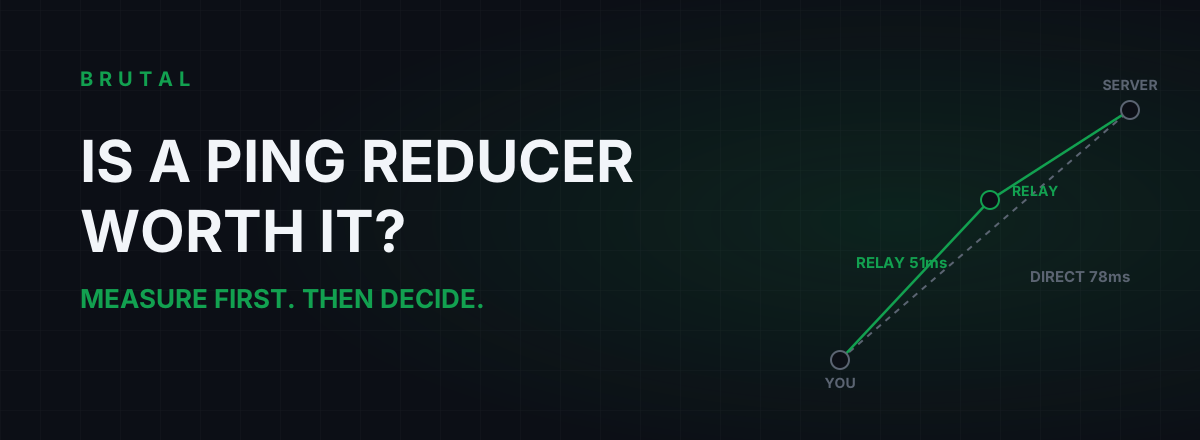
Is a Ping Reducer Worth It? A Decision You Can Test for Free
Most players don't need a ping reducer. Some genuinely do. A free ten-minute measurement tells you which one you are, before any subscription starts.
 Network & Latency
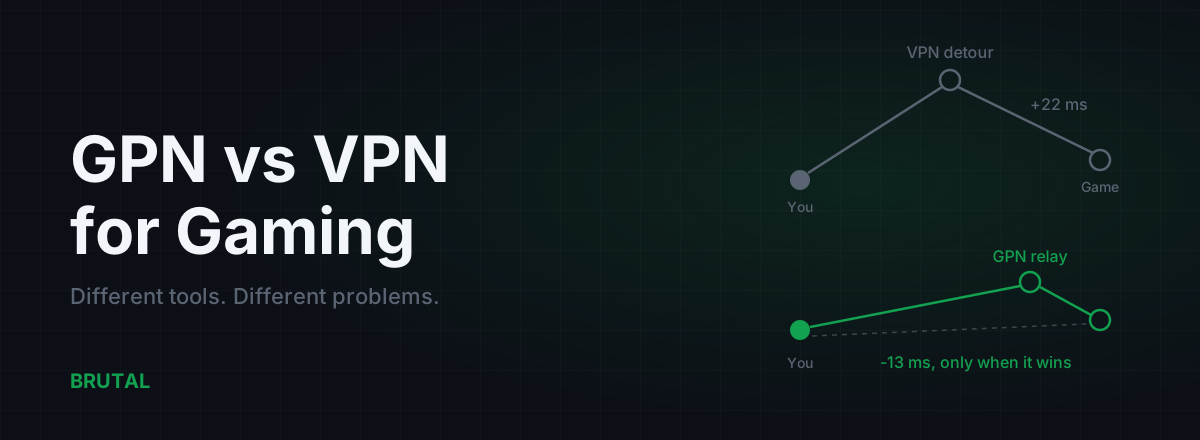
GPN vs VPN for Gaming: They Solve Different Problems
A VPN encrypts all your traffic for privacy and usually adds ping. A GPN reroutes only your game traffic, and only when a measurement says it helps. Here's when each makes sense.
 Network & Latency
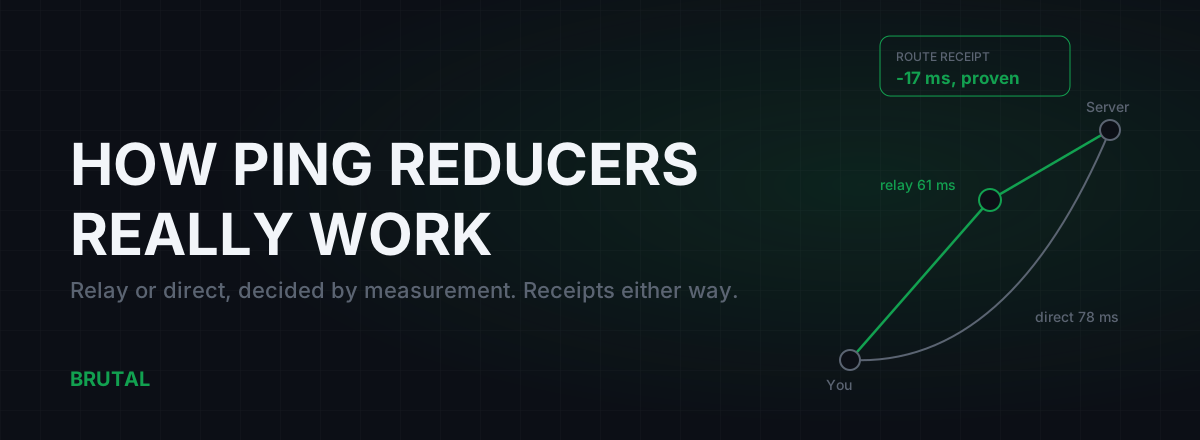
How Do Ping Reducers Work? Relay vs Direct, With Receipts
A ping reducer only helps when a relay path genuinely beats your ISP's route. Here's how Smart Route detects the server, measures both paths, and decides, with a receipt either way.
Stop guessing. Measure it.
BRUTAL Optimizer is the honest way to speed up Windows — 17 free modules, a real FPS overlay, verified disk cleanup and drive health. No kernel driver of our own, no game hooks, every setting change reversible.