Game Relay Server Location: Why the Nearest PoP Can Be Wrong
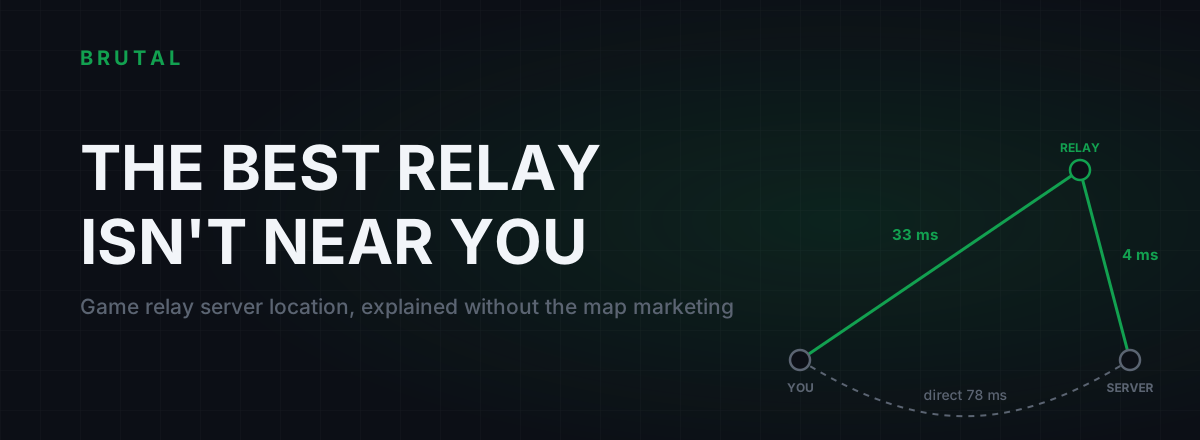
Game relay server location matters more than any other spec on a ping reducer's feature list, and most players' instinct about it is backwards. The best relay usually isn't the one nearest your house. It's the one sitting near your game server's region, just past the point where your ISP's routing goes wrong.
What game relay server location actually changes
A relay can't move you closer to the game server, and it can't push packets through fibre faster than light allows. It changes exactly one thing: which networks carry your traffic.
On a direct connection, your ISP chooses every hop between you and the server. It picks routes based on its own peering agreements and its own transit costs, not your latency. If the cheapest path from Delhi to a Mumbai game server happens to run through Singapore, that's the path your packets take, and you don't get a vote. We've covered why ISP paths to game servers go bad in detail, but the short version is that your ISP optimizes for its bill, not your ping.
A relay splits the journey into two halves you can actually influence. Your ISP only has to carry you to the relay. From there, the relay's network carries you to the server, usually over transit with direct, well-maintained peering toward the big hosting providers where game servers live.
That's the entire mechanism. No compression, no "packet optimization", no magic protocol. Just different roads. The physical floor stays fixed either way; if you want the absolute minimum ping your geography allows, check the speed-of-light ping floor first.
The nearest-PoP trap
Almost every VPN and booster app has a "fastest server" button. It pings the provider's nodes and picks the one with the lowest number. Feels scientific. It's measuring exactly half of the problem.
The ping to a relay only describes the first leg of your trip. It says nothing about how that relay reaches your game server. A node 8 ms from you that then routes your game traffic through a congested exchange on the far side is strictly worse than connecting direct. You paid an extra hop for nothing, and got a worse road in the bargain.
Here's a plain-numbers version. Say your direct ping to the server is 45 ms. The relay next door answers in 8 ms, but its path onward to the server takes 52 ms. Your total through the "fastest" relay is 60 ms. You just made things 15 ms worse while the app's server list showed you a lovely green 8.
The green number was real. It just wasn't the number that mattered.
The triangle inequality, and why real networks break it
In geometry, the detour always loses. Going from A to B through C can never be shorter than going straight. That's the triangle inequality, and it's why relays sound like snake oil to anyone who pictures the internet as a map.
But the "direct" route on the internet isn't a straight line. It's whatever chain of networks your ISP's commercial agreements produce, and it can be spectacularly indirect. Packets from Delhi to Mumbai genuinely do get routed through Singapore on some ISPs at some times. Traffic between two European cities sometimes crosses a third country because that's where two providers happen to interconnect.
Here's the detail most people miss: your ISP doesn't have one route to a city. It has a route to every destination network. The game server lives in one hosting provider's address space; a relay lives in another. Two machines in the same Mumbai building can be 33 ms and 78 ms away from you, because your ISP reaches one network over a clean domestic path and the other over an overloaded international one.
That's the loophole a relay exploits. You're not beating geometry. You're routing around a bad business decision.
Now the honest part: this kind of broken route is the exception, not the rule. For most player-and-server pairs, the direct path is already sensible, and adding a relay just costs you the extra hop, typically 2 to 5 ms. Maybe one connection in ten has a detour worth fixing, and even that is often specific to one ISP and one time of day. That's why measurement beats faith.
Near you or near the server: where the winning relay sits
So where should the relay be? Game relay server location comes down to a sharper question: which half of your route is broken?
If your ISP exits your region badly, meaning it hauls your traffic somewhere absurd before heading toward the server, you want off its network as early as possible. A relay near you, at the closest well-peered hub, does that. Your ISP only has to carry you across town, and the relay's transit handles the long haul properly.
If your ISP's long haul is actually fine but the final handoff into the game host's network is congested, you want the opposite: a relay in the server's region. Your ISP carries you most of the way on roads it runs well, and the relay does a short, clean final hop through a better front door.
In practice, mid-path and far-end breakage shows up more often than last-mile routing weirdness, which is why the winning relay usually sits in the same region as the game server, not in your city. Same-region placement fixes both common failure modes at once: it gives your ISP a well-peered destination it can route toward cleanly, and it makes the fragile final handoff short and local.
The best relay isn't the one closest to your house. It's the one standing just past the spot where your route goes wrong.
| Where the route breaks | Relay that wins | Typical saving |
|---|---|---|
| Nowhere; the direct path is clean | None. Stay direct | 0 ms; a relay adds 2-5 ms |
| Near you; your ISP exits the region badly | Close to you, at the nearest major hub | 10-30 ms |
| Mid-path; bad long-haul transit | Same region as the server | 20-60 ms depending on distance |
| Far end; congested handoff into the game host | Same city or region as the server | 5-25 ms |
Those numbers are ranges, not promises. Your route, your ISP, your evening congestion. The table tells you where to look, not what you'll get.
The same-region rule: fairness and account safety
Two very different things get called "using a relay in another region", and it's worth separating them.
The first is taking a better road to the same server. You're in Jakarta, your game's Asia server is in Singapore, and a Singapore relay reaches it cleaner than your ISP does. Nothing about your matchmaking changes. Same server, same opponents, same tick rate, just fewer wasted milliseconds on the way. That's what a relay is for.
The second is routing across the planet to force yourself into a different matchmaking region. That's a different activity with different consequences. Many games treat deliberate region evasion as a terms-of-service problem, and it doesn't even make sense on latency grounds: you're volunteering for 150 ms so you can farm an easier lobby. If a "ping reducer" is being marketed to you as a region switcher, it isn't selling latency.
Same-region relaying is also the boring answer to the cheat-detection question. A relay that carries your traffic without touching the game's process looks like a network path, because that's all it is. We've written up whether ping reducers are anti-cheat safe separately if you want the long version.
A worked example: our PoPs and why they're where they are
Smart Route's PoPs are in Singapore, Tokyo, Jakarta, Chennai, Bangalore, Delhi, Frankfurt, Bahrain, Sao Paulo, and Dallas. The list looks lopsided until you stop thinking about where players are and start thinking about where game servers and broken routes are.
Three of them are in India. That's not because India has a third of the world's players; it's because India has some of the messiest inter-ISP routing anywhere, and the popular mobile titles concentrate their servers in and around Mumbai. A Delhi player and a Chennai player hitting the same Mumbai server can need completely different fixes, and on some ISPs the direct route is already fine while a rival ISP in the same city detours internationally. If that's your daily reality, the BGMI ping guide for India goes deeper.
Singapore, Jakarta and Tokyo cover the East and Southeast Asian server clusters where a lot of competitive titles host. Frankfurt sits on one of the world's largest interconnection hubs and covers most of Europe. Bahrain covers Gulf players whose transit historically wanders before reaching Middle East server sites. Sao Paulo exists because Brazilian routing to Brazilian servers can be strange in exactly the way this article describes. Dallas covers the central-US server belt.
Notice what's missing: no PoP in most world capitals, no attempt to put a dot on every continent for the sales page. A PoP earns its place by sitting near a server cluster or a historically bad corridor. A relay somewhere no game server lives and no route breaks is decoration.
And placement is only half of it. Smart Route measures the direct path against candidate relays for your actual connection and your actual server, engages a relay only when the measurement shows a real win, and records "Direct won" when it doesn't. The decision logic is documented in how Smart Route decides relay or direct. A relay network that never tells you "direct won" is telling you something else about itself.
How to find where your route breaks
You don't need to buy anything to answer the only question that matters: is your direct route actually broken?
Run a traceroute toward your game's server region and read it like a map. Reverse DNS names on hops often contain airport or city codes, so you can literally watch your packets travel. Look for two things: geography that makes no sense, like a domestic connection bouncing through another country, and a single large latency jump between two adjacent hops, which marks the segment where the delay lives. Our traceroute guide for gamers walks through reading one line by line.
Time of day matters. A route that looks clean at 11 a.m. can congest at 9 p.m. when the whole neighbourhood streams. Test at the hour you actually play, and test more than once.
When relay location can't save you
A perfectly placed relay fixes exactly one class of problem: a bad path in the middle of the internet. Plenty of lag lives elsewhere.
If your Wi-Fi drops frames every time someone walks past the router, no relay location helps. If your ping triples when someone in the house starts a download, that's bufferbloat in your own router, and it happens before your packets ever leave the building. If your line loses packets, a relay will carry that loss faithfully to its destination.
And if you're 130 ms from the server because you're playing on another continent, that's physics, not routing. Fibre distance sets a floor no relay placement can dig under.
One-line summary of the whole article: game relay server location decides whether a relay can win, and measurement decides whether it did. The nearest dot on the map answers neither question. Find where your route breaks, put the relay just past that point, and if nothing's broken, play direct and keep your milliseconds honest.
Frequently asked questions
Should I connect to the relay server closest to me?
Not by default. The ping to a relay only measures the first leg of the trip; what matters is the full path, you to relay to game server, compared against direct. The winning relay usually sits in the same region as the game server, because that's where routes most often go wrong. Measure the whole trip, or use a tool that does it for you.
Does relay server location matter for every game?
It matters whenever a relay is in play, but most connections don't need a relay at all. If your ISP already routes cleanly to the server, every relay location loses to direct by a few milliseconds. Location decides whether a relay can win; a measurement decides whether it actually did.
Is it safe to use a relay in a different region than my game server?
Same-region relaying to reach your own server faster is just a network path and doesn't touch matchmaking. Deliberately routing across regions to enter a different matchmaking pool is a terms-of-service risk in many games, and it adds latency rather than removing it. Keep the relay in the server's region.
How do I know if a relay would lower my ping?
Run a traceroute to your game server's region at the time you actually play. If you see a geographic detour or one big latency jump mid-path, a well-placed relay may fix it, typically saving 10-60 ms depending on how bad the detour is. If the route looks sensible, expect a relay to cost you 2-5 ms instead of saving anything.
Why do ping reducers have servers in so few cities?
Good ones place PoPs near game-server clusters and known bad routing corridors, not evenly across a marketing map. A relay in a city with no nearby game servers and no broken routes has nothing to fix. A handful of well-placed PoPs can beat fifty decorative ones.
Keep reading
 Network & Latency
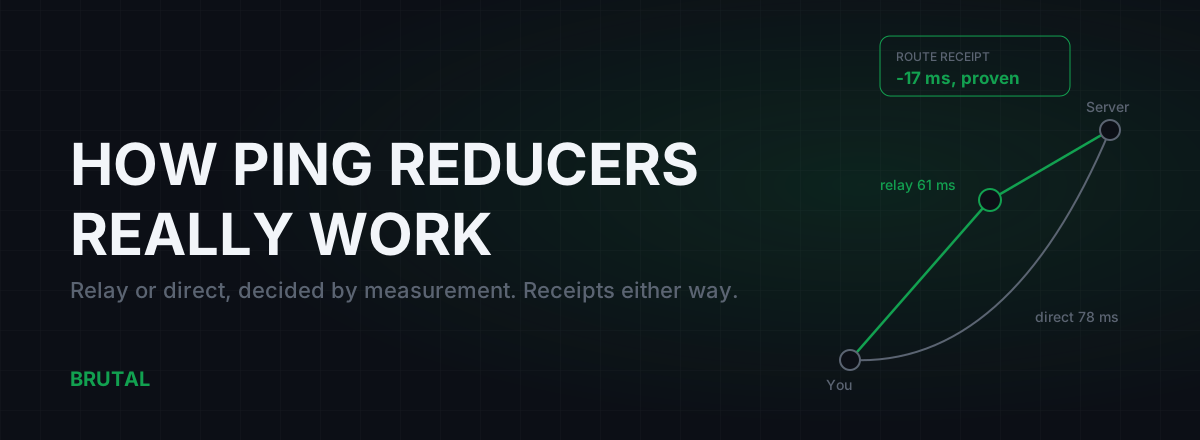
How Do Ping Reducers Work? Relay vs Direct, With Receipts
A ping reducer only helps when a relay path genuinely beats your ISP's route. Here's how Smart Route detects the server, measures both paths, and decides, with a receipt either way.
 Network & Latency
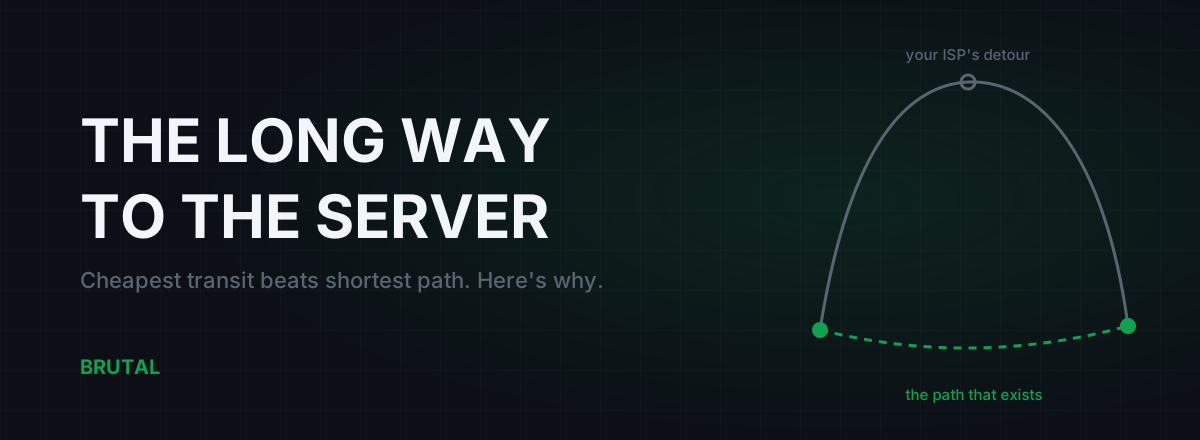
Bad Routing to Game Servers: Why Your ISP Takes the Long Way
Your ping to a game server is often set by ISP economics, not distance. Here's how BGP picks the cheap path over the fast one, how to spot the detour, and what actually fixes it.
 Network & Latency
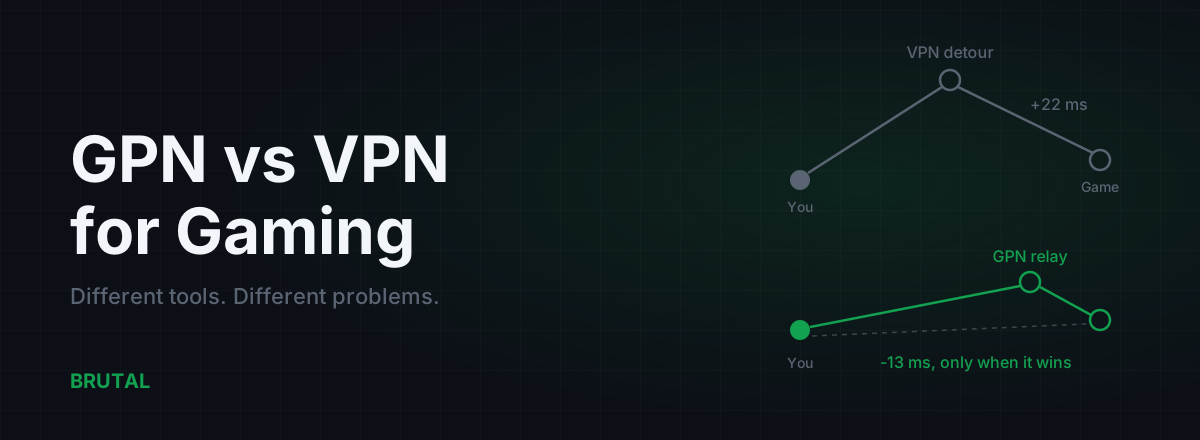
GPN vs VPN for Gaming: They Solve Different Problems
A VPN encrypts all your traffic for privacy and usually adds ping. A GPN reroutes only your game traffic, and only when a measurement says it helps. Here's when each makes sense.
Stop guessing. Measure it.
BRUTAL Optimizer is the honest way to speed up Windows — 17 free modules, a real FPS overlay, verified disk cleanup and drive health. No kernel driver of our own, no game hooks, every setting change reversible.